

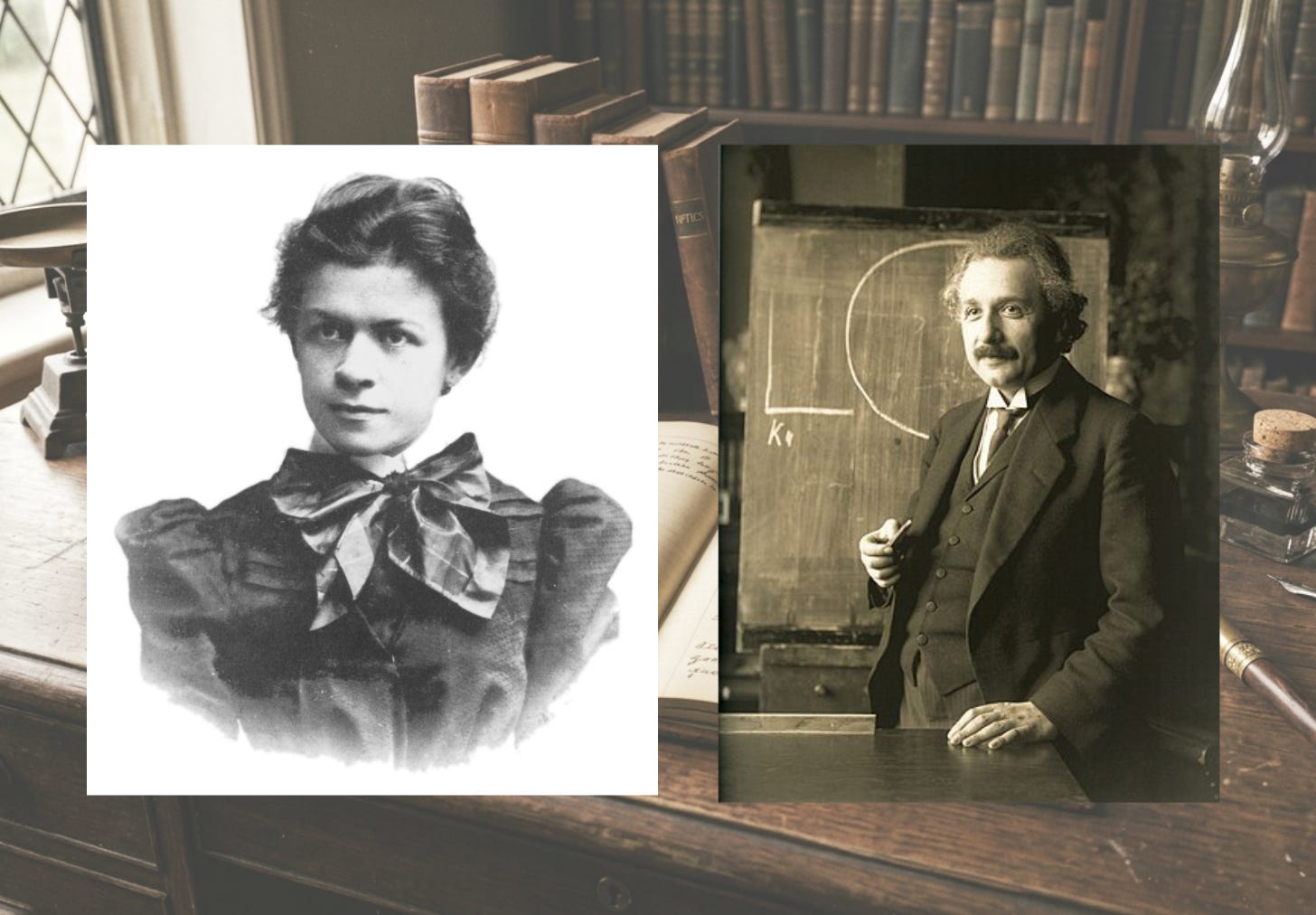
The idea that a woman helped write Einstein’s papers has gained ground. It is a concept that some of the greatest minds today find hard to contemplate.
It was an idea suggested in Marie Benedict’s book The Other Einstein. Although marketed as a work of fiction, it was based on fact.
Mileva Maric was Albert Einstein’s first wife. It is suggested that she contributed to some of his biggest theories. Did Einstein plagiarise his wife’s work to achieve success?
Who Is Mileva Maric?
Mileva was a Serbian physicist and mathematician. She was also the only woman at the Zurich Polytechnic in the same year as Einstein, and only the fifth woman accepted to the Mathematics and Physics department.
As a child, she showed exceptional talent for her studies, especially mathematics. Because of her intelligence, she was allowed to enter the all-male Royal Classical School in Zagreb. When she qualified to enter Zurich Polytechnic, she moved to the city, a woman on her own, in a man’s world.
She entered Einstein’s class and fell for him. Love letters of the time sent between the two show their intense relationship. She went on to have his first child out of wedlock: a girl named Lieserl. Mystery surrounds what became of this child; some say she died of scarlet fever, others that she was adopted. After marriage, the couple had two sons, Hans Albert and Eduard.
The couple divorced in 1919.
What did Mileva Contribute?
While studying in Zurich, Mileva took a term off to study in Heidelberg. In a letter dated 20 October 1897, she wrote about her fascination with the relationship between a molecule’s velocity and the distance between them. This topic is highly relevant to Einstein’s studies of Brownian motion, one of the four papers he published in 1905 during his landmark year.
There are doubts about whether Mileva helped him write his four groundbreaking papers in Annalen der Physik.
The fourth of these papers was the basis of his Theory of Relativity. Within the articles, Einstein pays tribute to his friends from the Olympia Academy. This small group of forward-thinking minds met regularly to debate and discuss theories. Along with Einstein, Mileva is mentioned as a member of this Academy.
The Evidence
In recent times, many minds have debated Mileva’s contribution to these theories. It is clear that at the time, theories from a man would have been far better received than from a woman, especially a woman who failed to graduate.
Mileva was pregnant during her finals and failed to reach the academic achievement she should have, even though in previous years she had scores equal to Einstein’s.
A recent documentary claims to have uncovered an original copy of the Theory of Relativity. The paper is signed by both Einstein and Marity. Is Marity a misspelling of Mileva, or perhaps the official Hungarian form of her surname used on official documentation? Abraham Joffe, an alumnus of Zurich Polytechnic Institute, claims to have also viewed this original document.
Letters exist between Mileva and a Serbian friend in which she claims that they had just finished important work that would make her husband famous.
John Stachel, a well-known physicist, argues that the letters referring to this collaboration were written during Einstein’s student days, long before the papers were published. He also points out that while Einstein often used the pronoun “our” rather than “I” when discussing his ideas in personal correspondence, this reflected romantic intimacy rather than concrete scientific co-authorship. This, he claims, supports the view that Mileva was not a co-author of the published theories.
Stachel suggested that letters from Mileva survive that directly respond to those from Einstein. When he speaks of his latest ideas, she gives no response at all. Her letters contain only personal matters or comments related to her Polytechnic coursework.
Stachel writes: In her case, we have no published papers, no letters with serious scientific content, either to Einstein or anyone else, nor any objective evidence of her supposed creative talents. We don’t even have hearsay accounts of her conversations with anyone else that have specific scientific content, let alone claims of reporting her ideas.
In contrast to Stachel’s view, Mileva’s eldest son and relatives remember her working on papers alongside her husband.
One of the most significant clues to these claims may be that Einstein put all the money he made from his Nobel Prize into a fund for Mileva and his two sons. Was he a father who provided for his family, or was he paying dues to a co-author?
Whether Mileva contributed to some of Einstein’s theories remains to be proven.
Einstein was a genius in his own right. Whether he refused to acknowledge his wife’s contribution does not necessarily make him a thief. It may be that his wife inspired him through their lively dinner conversations.
The papers that both parties have left are compulsive reading.
The primary issue remains that Mileva Einstein has been eliminated from mainstream history, like so many women. Very few people know the name of one of the most impressive female physicists of her time.
5 Ancient Technologies Science Still Can’t Fully Explain

Talk about Atlantis being a civilisation that existed years ago which was far more advanced than ours, and some will call you a conspiracy theorist. However, there are some facts these sceptics cannot argue with, and that is the number of ancient technologies which we simply cannot replicate.
Subscribe today: I spend hours digging through archives, old testimony, and forgotten files to bring these cases to life. Free posts are just the beginning, paid subscribers keep this work possible and get access to my full vault of articles.
If you’ve enjoyed this story and want to see more, please consider upgrading. It’s readers like you who keep Murder Mayhem UK alive.
Sam, this is astonishing! Reminds me of James Watson taking the x-ray images of the DNA molecule that Rosalind Franklin made--Photo 51--and showing the x-ray to Frances Crick. They used Photo 51 to create their model of the DNA molecule.
They gave no credit to Rosalind Franklin. Eventually, the source of the x-ray was revealed. Watson and Crick were awarded the Nobel Prize. By that time, Rosalind Franklin had died, and was not included in the Prize. The Nobel committee does not award the Prize to a deceased recipient, which I think is absolutely WRONG.
I have no difficulty believing that Einstein's wife was part of those amazing papers, but was denied credit for her contributions.
Once again, Sam, you've delivered a believable and amazing look at a woman's contribution to science.
HUGS!
Linda