

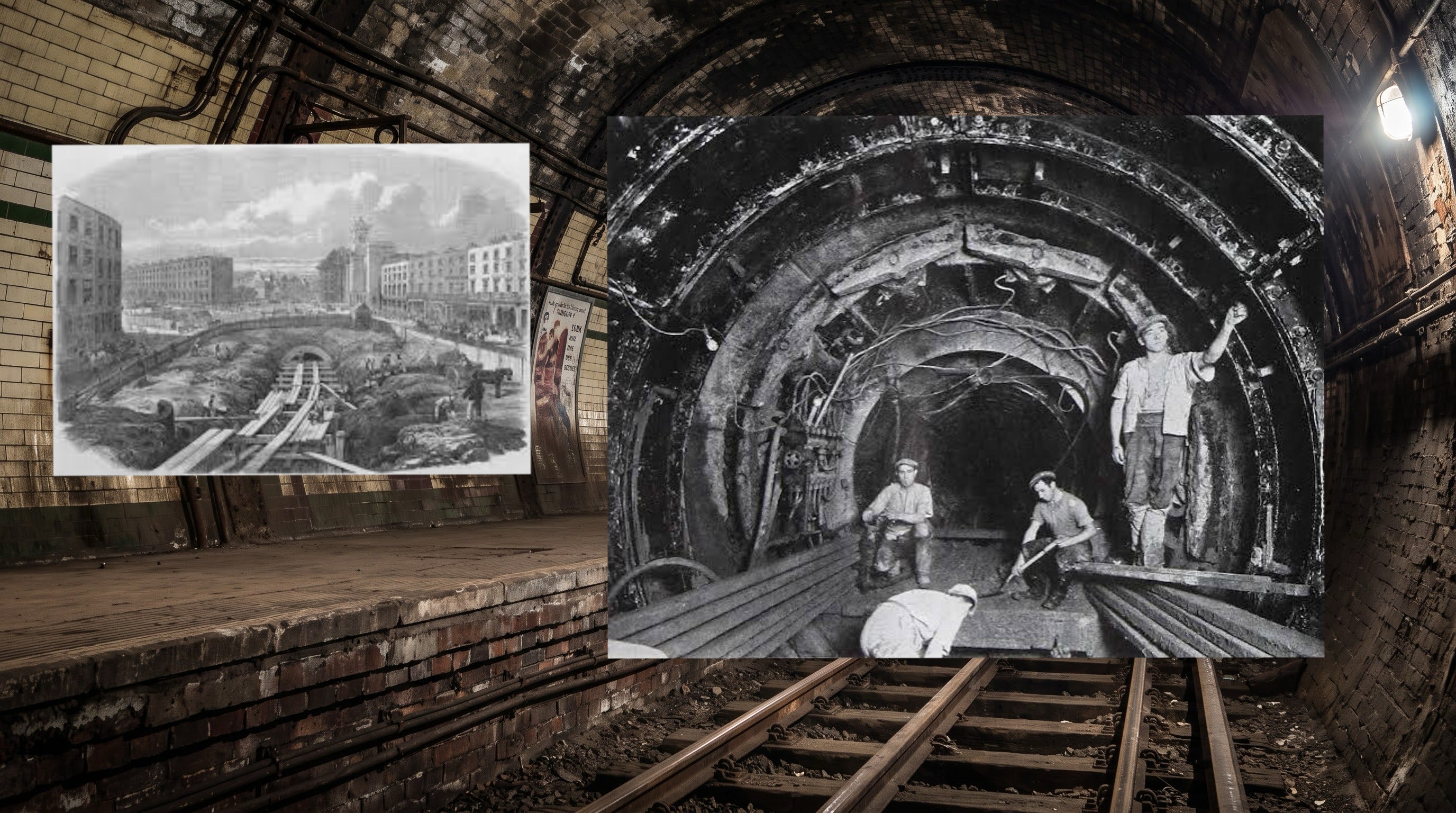
If you thought congestion was bad in London now, that was nothing compared to Victorian England. The streets were saturated with horses, carriages, and people moving about their daily lives.
London Bridge was so congested that it would take several hours to cross. Something needed to be done to clear the roads, but what? No one thought of the congestion charge; perhaps Victorian society was more advanced than we thought.
The idea that came about was considered as strange as the congestion charge was to us: let’s build an underground railroad to travel through.
Construction
Charles Pearson was the first person to come up with the idea of an underground railway, though it took several years for this idea to be realised. Not until 1860 was work started on the Metropolitan line.
Many would have thought that Londoners would have been apprehensive about travelling underground on a train, but this was not so. On the first day, 38,000 people travelled; however, it was not the luxury it is now—the engines were steam and the carriages were open air.
The first lines were built by digging down from above, laying the track and a tunnel over it, and then filling in the hole created. You could tell where the line was being laid because of the giant hole that preceded it.
Advancing Technology
This did not last long, and as technology advanced, the line began to be built using a boring machine. Workers dug the tunnel out, and the tunnel was covered as it went before moving forward to dig the next part out.
The opening and expansion of the Underground led to London expanding, as more houses could be built further out and people could commute in.
By 1890, Londoners were sick of the steam and arriving everywhere smelling of coal. Steam was ditched and replaced with electric trains, making travel far more comfortable.
Ecosystem
The subterranean system even holds its own distinct biological history. Isolated underground since the construction of the network, populations of Culex pipiens molestus adapted to the dark, warm conditions of the tunnels.
This unique variety of mosquito, famed for biting wartime Londoners sheltering on platforms during the Blitz, evolved distinct traits, including breeding without needing an initial blood meal and losing the ability to hibernate during winter.
War Effort
The Underground was greatly utilised during both world wars. Stations were used as bomb shelters for people to flee to. During World War II, Down Street station was used as a central command centre for Winston Churchill.
However, it did not always save lives. On 3 March 1943, Bethnal Green Underground station was the site of the single largest loss of civilian life on the UK transport network during World War II.
Following the sound of air raid sirens and nearby test firings of new anti-aircraft rockets, hundreds of people hurried down the dimly lit staircase leading to the station, which was being used as a deep-level air-raid shelter. In the crowd, a woman holding a child tripped near the bottom of the unlit steps.
The sudden stumble triggered a catastrophic domino-effect crush in the dark. A total of 173 people, mostly women and children, were asphyxiated or crushed to death within minutes, even though no bombs were dropped that night.
Tunnels were also repurposed as secure storage vaults during the Second World War. The British Museum transferred some of its most precious holdings, including sections of the Parthenon Sculptures (the Elgin Marbles) and other irreplaceable ancient artefacts, into disused tube tunnels and subterranean spaces to protect them from Blitz bombing raids.
Terrorism
Decades later, London’s transport system faced tragedy again in the modern era during the 7 July 2005 suicide bombings (often referred to as 7/7), which struck three Underground trains and a double-decker bus.
These were a series of coordinated Islamist suicide bombings targeting Londoners during the morning rush hour. It was the first time suicide bombers had struck UK soil, claiming the lives of 52 commuters and injuring more than 700 others. The attack on public transport a day after London won the 2012 Olympics turned the capital’s mood from celebration to crisis.
At 8:49 am, three explosions were detonated near-simultaneously on three separate London Underground trains. The first bomb exploded on a Circle line train between Liverpool Street and Aldgate, killing seven people. Moments later, a second bomb went off on a Circle line train near Edgware Road, killing six.
The third and most devastating Underground blast occurred on a deep-level Piccadilly line train travelling between King’s Cross St Pancras and Russell Square, where the enclosed tunnel amplified the destruction and killed 26 people.
Roughly an hour after the initial Tube explosions, a fourth suicide bomber detonated his device aboard a crowded double-decker bus in Tavistock Square. The attacker had originally planned to detonate his bomb underground alongside the others, but transport delays forced him onto the streets. The explosion tore through the upper deck of the No. 30 bus, killing 13 passengers. Images of the destroyed red bus quickly became the tragic defining symbol of the tragedy.
The four perpetrators—Mohammad Sidique Khan, Shehzad Tanweer, Germaine Lindsay, and Hasib Hussain—were young British citizens carrying homemade explosive devices packed into backpacks. Three had grown up in West Yorkshire, while Lindsay lived in Buckinghamshire.
In the aftermath, the city faced immense logistical disruption, with the entire Tube network shut down and mobile phone networks overloaded. Today, a permanent memorial featuring 52 stainless steel pillars stands in Hyde Park to honour each of the victims who lost their lives that morning.
Curiosities.
London’s daily travel leads to a large number of lost items handled by Transport for London. The Lost Property Office processes over 350,000 items annually, with most being everyday essentials like phones and coats. Staff have also found unusual items like an inflatable boat and a kitchen sink.
The London Underground has its own breed of mosquitoes, Culex pipiens molestus, adapted to the dark, warm conditions of the tunnels. This unique mosquito, known for biting wartime Londoners sheltering on platforms during the Blitz, evolved traits like breeding without an initial blood meal and losing hibernation abilities in winter.
The London Underground was revolutionary and inspired undergrounds in cities like New York, Paris, Tokyo, Moscow, and many others. It’s an engineering marvel that most people have travelled on.
Be sure to check out our deep-dive article on Monday when we look at the Ghost stations associated with the London Underground.
Subscribe today: I spend hours digging through archives, old testimony, and forgotten files to bring these cases to life. Free posts are just the beginning, paid subscribers keep this work possible and get access to my full vault of articles.
If you’ve enjoyed this story and want to see more, please consider upgrading. It’s readers like you who keep Murder Mayhem UK alive.
Don’t want to commit then consider leaving me a tip if you enjoyed this article.
