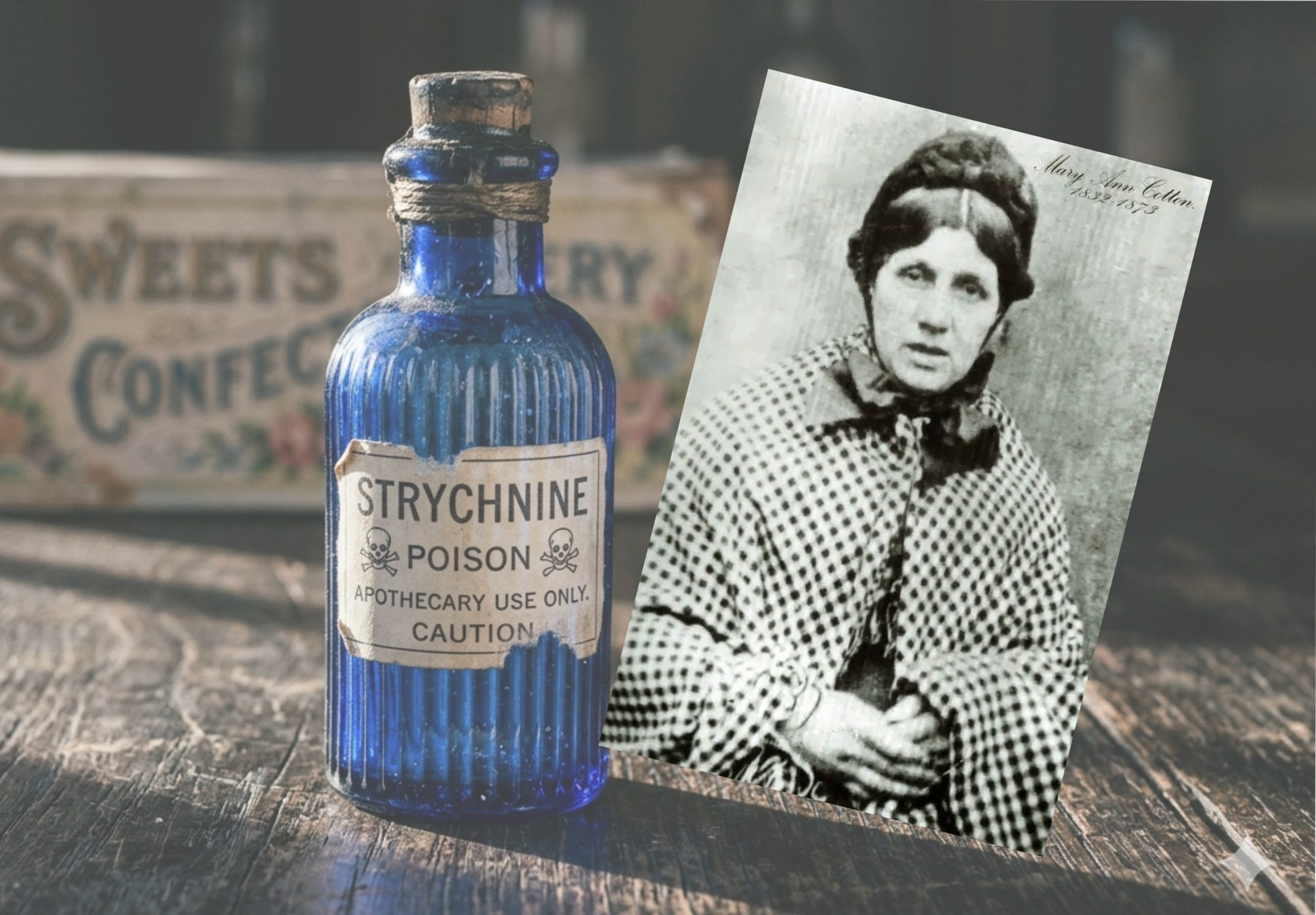
Mary Ann Cotton Was the Most Prolific Female Serial Killer in UK History
Another danger in Victorian times.
For more than a century, Mary Ann Cotton was the most prolific serial killer in UK history, until Harold Shipman surpassed her victim count in 2000. She was described as beautiful, charming, and ultimately deadly, earning her the nickname “Black Widow” after the deadly spider.
It has been suggested that Cotton killed at least 21 people. Many of these were her children or husbands. Records show that she had at least 13 children during her life, yet only 2 of these outlived her. Similar to Mary Ann Bateman, a serial killer 100 years before, her weapon of choice was arsenic poisoning. Her main motive for the murders was to collect the insurance money that each death provided her with.
Early Life
Cotton was born into a mining community in Sunderland. Her father, Michael Robson, was a collier sinker. She had two siblings, but only her younger brother survived. When Cotton was eight, the family moved to County Durham. Like many families of the time, they travelled where the work was. She was a good student and a friendly girl. Her Sunday school superintendent would describe her as: “a most exemplary and regular attender, a girl of innocent disposition and average intelligence.”
In 1842, Cotton’s father was killed after he fell down a 150ft mine shaft. The times were very harsh. His body was delivered to the family in a sack, along with the news that they would need to vacate the mining property they were living in. This situation did not last long, as Cotton’s mother remarried in 1843 to another miner.
At sixteen, Cotton left her home to become the nursemaid to the manager of Murton Colliery, where she cared for his children. When the children grew up, she returned to her stepfather’s home for a short period whilst she trained to be a dressmaker. It would not be long before she would start working her way through her husband’s.
The Life of a Married Woman
Cotton married her first husband when she was 20. Like her father, he was a colliery labourer called William Mowbray. During her time with Mowbray, she would go on to mother many children; estimates suggested nine. Only one would survive. No records exist of these deaths, even though registration was compulsory at the time. It is hard to establish what they died of or the exact numbers. In January 1865, Mowbray died of what was noted as intestinal problems. Cotton collected £35 on his death, which was the equivalent of six months’ wages.
Cotton went on to start working in a local infirmary after Mowbray’s death. It was during this time that she met husband number two. George Ward was an engineer and a patient at the time. Entranced by his nurse, he married her in August 1865. His health was poor at the time, and was about to become worse. Cotton, who did not want a child living with them, sent her daughter to live with her mother. It is unclear why she chose this course of action, rather than killing her. Ward would die in October 1866 of intestinal problems, leaving Cotton to collect the insurance money.
The next man on Cotton’s radar was James Robinson, who was a shipwright. He hired Cotton as a housekeeper shortly after his wife died. When his son died one month later of gastric fever, he turned to his housekeeper for comfort. Whilst helping Robinson deal with his grief, Cotton fell pregnant.
At this point in her life, Cotton received notification that her mother was ill, so she went to look after her. Her mother made good progress and started recovering, only to fall ill with stomach pains. She died nine days after Cotton arrived, at the age of 54. Cotton returned to Robinson with her daughter, who had been staying with her mother. Shortly after returning to Robinson, her daughter became ill with a stomach complaint and died. Two of Robinson’s children suffered the same fate. Cotton went on to collect the insurance money.
After these events, and with a child on the way, Robinson married Cotton, and the happy couple went on to have two children. Only one of these children would survive. Cotton was eager after these unfortunate events to get her husband insured. It is this insistence that raised the suspicion of Robinson. Whilst checking his bank, he found that Cotton had run up a huge debt in his name and had pawned many of the family’s valuables. He threw her out, keeping custody of their son.
After this, Cotton was forced to live on the streets. When her friend, Margaret Cotton, introduced her to her brother, a pitman and recent widower, Cotton was only too happy to help. Margaret had been acting as a surrogate mother to her brother’s children. When Margaret died in March 1870 from stomach problems, Cotton was there to comfort Frederick. Shortly after this, she found out that she was pregnant with her twelfth child.
The marriage to Cotton was not to be a faithful one. Cotton heard that a previous love, Joseph Nattrass, was living close and rekindled her romance with him. In December the same year, Frederick died from gastric fever and Cotton collected still more insurance money. After the death of Frederick, both his sons also died of gastric fever, and then Cotton’s son would suffer the same fate. The last person to die of gastric problems was Nattrass.
The Black Widow Uncovered
After these latest deaths, Cotton went to work for Thomas Riley, a parish official. She complained to him about her son being a problem and asked if she could have him committed to the workhouse. When Riley informed her this would only be possible if she accompanied him, she replied: “I won’t be troubled long. He’ll go like the rest of the Cottons.”
Five days later, Charles Edward died, and Riley went straight to the police. The boy was examined and showed clear evidence of arsenic poisoning. The decision was then made to exhume both Nattrass and some of Cotton’s children. They all showed signs of arsenic poisoning.
The papers latched onto the story of the Black Widow. During their research, they discovered how much Cotton had moved around the country. They also noted the number of people she had lost to stomach fever. Dr William Byers Kilburn, who was Charles’ doctor, had kept samples from his patient. When these were tested, they showed arsenic poisoning.
The End of a Serial Killer
Cotton stood trial on 5th March 1873, the trial having to be delayed so that she could give birth to her final child. After deliberating for 90 minutes, the jury found her guilty on all charges. Out of the 13 children she was believed to have had, only two went on to survive: the son that Robinson claimed custody of and the daughter, Margaret Edith, born in jail.
Cotton was hanged in Durham jail on 24th March 1873. In a strange twist, she didn’t die of a broken neck, but rather strangulation. The executioner had rigged the rope too short, so a broken neck did not happen. Whether this was on purpose or not was never established.
In the 1990s, Durham jail was modernised, and Cotton’s remains were removed, amongst others. Her bones were found with a pair of her shoes; they were later cremated and rest in an undisclosed location.
Be sure to check out our deep dive article on Monday when we look at another female killer who liked to poison her victims.
Subscribe today: I spend hours digging through archives, old testimony, and forgotten files to bring these cases to life. Free posts are just the beginning, paid subscribers keep this work possible and get access to my full vault of articles.
If you’ve enjoyed this story and want to see more, please consider upgrading. It’s readers like you who keep Murder Mayhem UK alive.


