Kunigunde Mackamotzki was a woman of many names, but history remembers her by a name she never truly owned: Cora Crippen. The daughter of a Russian-Polish father and a German mother, she would eventually become the victim in one of the most sensational cases of the Edwardian era.
Critics often argue that historians have failed to give Cora her due credit. Far from the caricature often presented, she was a hardworking woman who championed the fortunes of her peers. However, history typically paints her as an overbearing and dominant character who overshadowed her husband.
Hawley Harvey Crippen initially supported her ambitions to become an opera singer. When those dreams faltered, she pivoted to a career as the Treasurer of the Music Hall Ladies’ Guild in London.
A Marriage of Convenience
The couple were not always unhappy; like most newlyweds, they began their life together fairly content. In September 1905, they took a lease on a property in Hilldrop Crescent, Holloway. This move was driven by a specific desire: the luxury of separate bedrooms.
According to Crippen, Cora had never been a particularly sexual person, making the new arrangement practical. He later remarked that intimacy vanished entirely by 1907. This didn’t seem to trouble him, however, as his heart already belonged to someone else.
Out with the Old, In with the New
The new object of Crippen’s desires was Ethel Le Neve, a quiet typist in his employ. Almost exactly as his physical relationship with Cora ended, his affair with Ethel began. This double life persisted for three years, reaching a breaking point in 1910.
On 31st January 1910, the Crippens hosted a dinner party for two of Cora’s close friends, Paul and Clara Martinetti. While the evening was mostly pleasant, one incident soured the air. When Paul Martinetti asked to use the toilet, Crippen failed to escort him upstairs. Cora publicly berated her husband for the lapse in etiquette.
By the time the Martinettis left in the early hours of 1st February, they had no idea they were the last people to see Cora alive.
A Missing Wife
As the weeks passed, friends began to wonder where Cora had gone. Crippen’s story shifted like sand; first, he claimed she had returned to America. Later, he insisted she had fallen ill. Finally, he announced she had died.
Suspicion turned to outrage when friends spotted Ethel Le Neve flaunting Cora’s prized jewellery in public. Even more scandalous was the fact that Ethel moved into the Crippen home by the end of February. Concerned, Cora’s friends contacted Scotland Yard.
On 8th July, Chief Inspector Walter Dew visited Hilldrop Crescent. Crippen met him calmly and offered a new explanation: Cora had left him for another man, likely Bruce Miller, an American she had met years prior. Dew was half-convinced but suggested Crippen place an advertisement in the newspapers asking Cora to confirm her whereabouts.
The Pursuit
Sensing the noose tightening, Crippen took drastic action. On 9th July, he shaved off his distinctive moustache and disguised Ethel as a boy. They fled to Brussels and boarded the SS Montrose, bound for Canada, posing as a father and son.
Back in London, Dew returned to the house to find it empty. A more thorough search of the damp cellar revealed loose bricks. Beneath them lay a grisly discovery: headless, limbless, and “boneless” human remains.
Aboard the Montrose, Captain Kendall noticed the “father and son” were unusually affectionate, frequently holding hands. Suspicious of the boy’s ill-fitting clothes, Kendall used the newly invented wireless telegraph to alert Scotland Yard, the first time this technology was ever used to catch a criminal. Dew boarded a faster ship, the SS Laurentic, and raced across the Atlantic.
On 31st July, Dew intercepted the Montrose on the St Lawrence River. Crippen and Ethel were arrested and escorted back to England to face the music.
The Trial and a Modern Twist
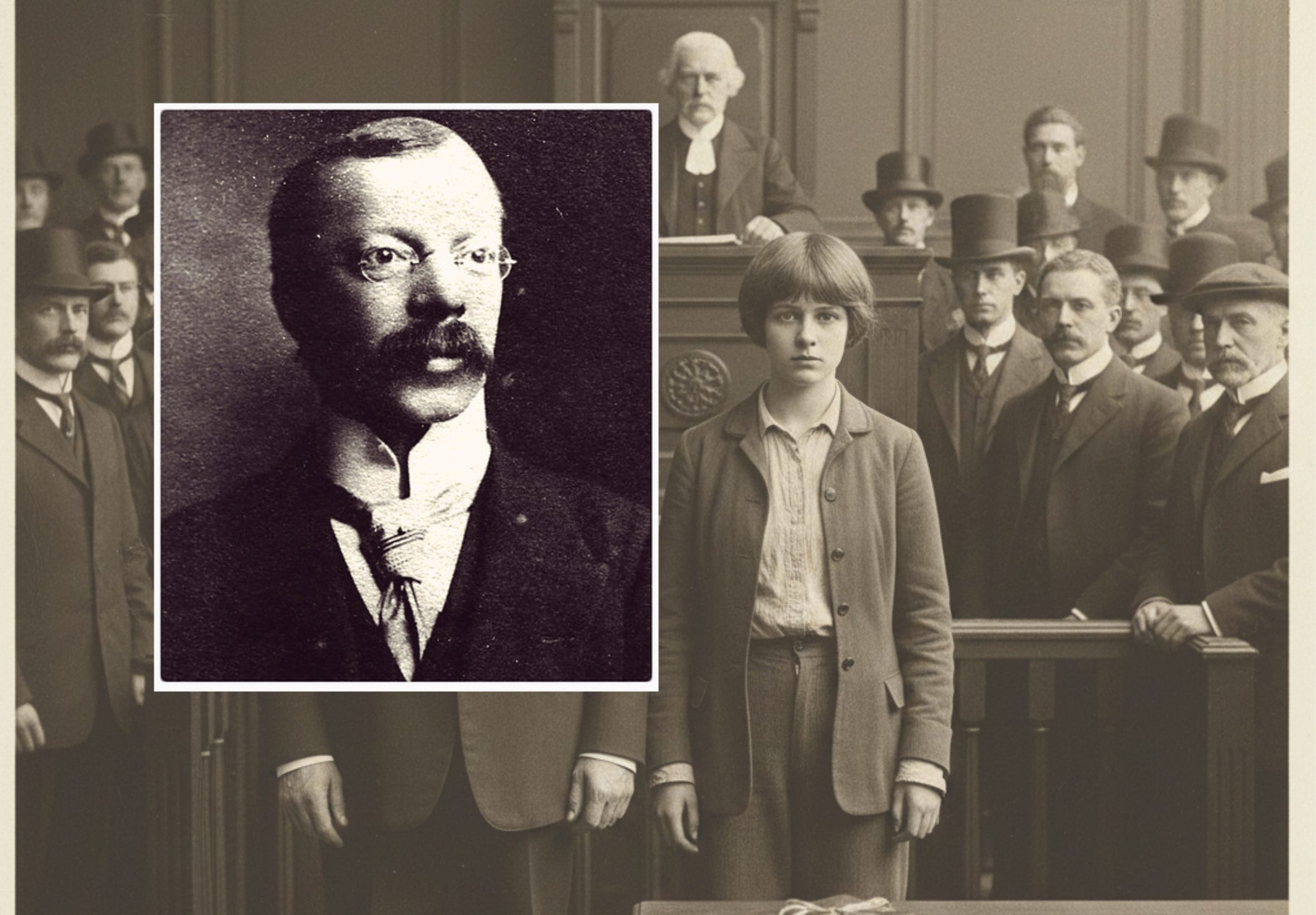
Crippen stood trial alone at the Old Bailey in October 1910. His defence was that the body had been planted in the cellar before he ever moved in. However, the prosecution produced a piece of skin with a scar matching Cora’s and a pyjama jacket found with the body that was traced to a 1908 manufacturer. Furthermore, traces of the poison hyoscine were found in the remains, a substance Crippen had purchased just weeks before Cora vanished.
It took the jury only thirty minutes to find him guilty. Ethel was tried separately as an accessory and acquitted. On 23rd November 1910, Crippen was hanged at Pentonville Prison. His final request was to have Ethel’s letters and photograph buried with him.
The DNA Controversy
While the case seemed closed for a century, modern science has cast doubt. In 2007, forensic scientists at Michigan State University tested mitochondrial DNA from the original tissue samples used in the trial. Their findings were shocking: the DNA did not match Cora’s maternal relatives, and further testing suggested the remains in the cellar were actually those of a male. If true, this implies the body wasn’t Cora’s at all, raising the haunting question of who really lay beneath the floorboards and whether Crippen was truly her killer.
Be sure to check out our deep-dive article on Monday, where we look at a Victorian incident: The Clerkenwell Bombings.
Until next Wednesday: Stay safe, stay curious.


