The urge to explore places that push your body to the limit, has always fascinated me. This started when I was in my 20s, when I met the son of Ernest Shackleton and learned about his amazing adventures.
His son’s house included memorabilia from his father. It was then that I started reading stories about adventure and survival. None have fascinated me more than the stories from Everest.
Located in the Mahalangur Himal sub-range of the Himalayas, Everest straddles the border between Nepal and China. It is the highest mountain on Earth above sea level, with an official elevation of 8,848.86 metres (29,031.7 feet). I have flown past it just once, and I cannot explain the rush of excitement it gave me.
A small part of me would love to climb it, but the realist in me knows I am not young enough, fit enough, or dedicated enough. So instead, I live vicariously through the people who have.
However, not all these explorers live to tell the tale of reaching the highest place on Earth. Sandy Irvine and George Mallory are two famous cases who sadly perished, possibly after reaching the summit. They are two of the many climbers whose bodies remain on Everest.
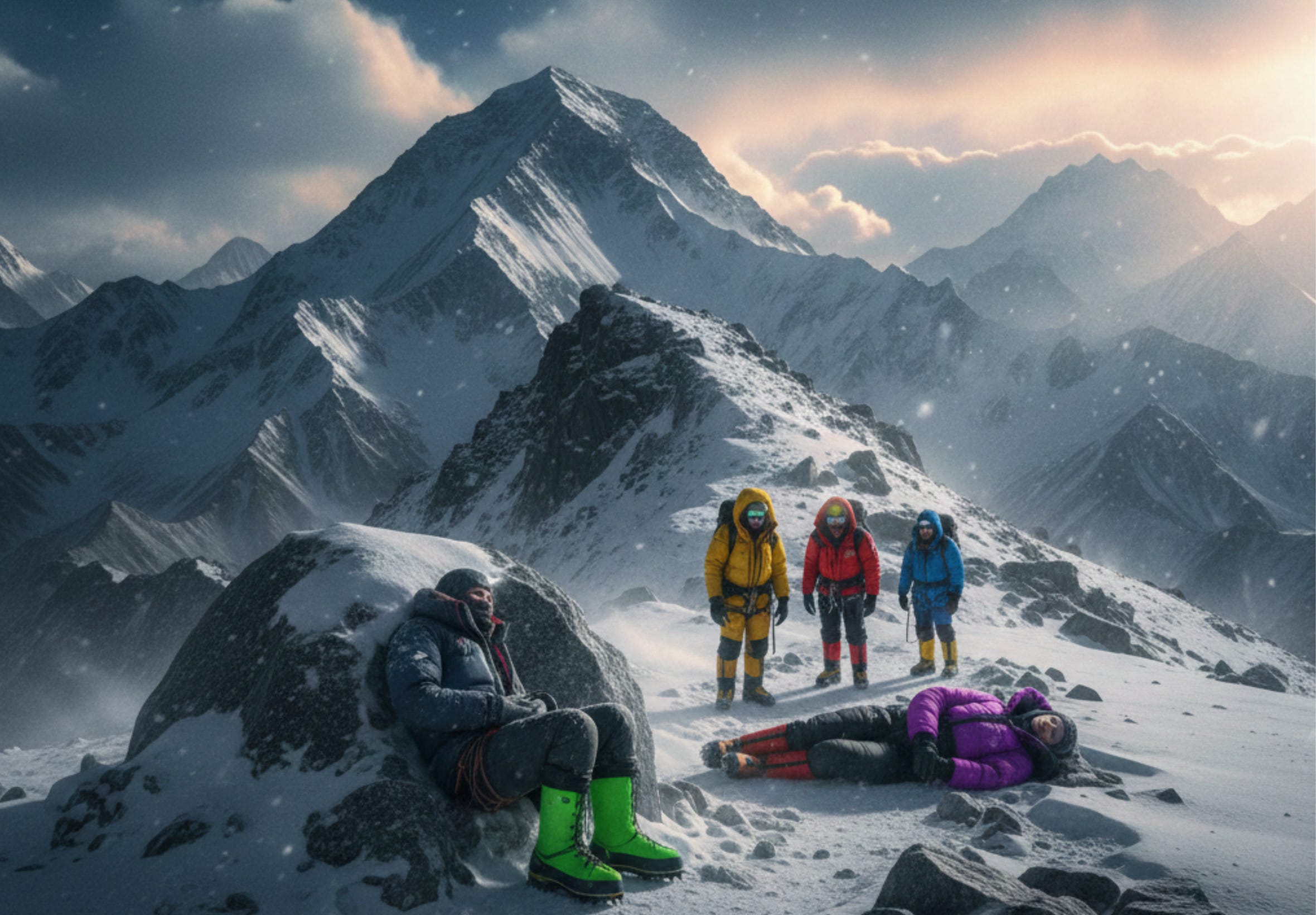
There are believed to be over two hundred bodies still on the great mountain, and more are added every year. Only a few corpses have ever been officially recovered. As you make the climb, you walk past many frozen bodies, and they have become a macabre form of signposting.
The 1996 Storm
Eight of the bodies were added to the count in May 1996, when a combination of a freak storm and the growing popularity of Everest resulted in a catastrophic loss of life. It is known as one of the deadliest days in Everest’s history.
Around 1996, companies started offering mass explorations of Everest with professional help. Most of the time, the climbers who attempted the ascent had minimal experience.
On 10th May 1996, several commercial teams were heading for the summit. Two of these groups were led by Rob Hall (Adventure Consultants) and Scott Fischer (Mountain Madness). They attempted to summit simultaneously, which congested the route. With the lack of oxygen, extra time in the Death Zone, waiting for others to pass, can be fatal.
The Death Zone on Mount Everest is the area above 8,000 metres (26,247 feet), where the atmospheric pressure is so low that a climber’s breath contains only about one-third of the oxygen available at sea level. Even with supplemental oxygen, climbers must minimise their time in this zone, ideally less than 20 hours, as the masks they wear can freeze.
On 9th May, both Adventure Consultants and Mountain Madness were at Camp IV preparing for the final push to the summit. The weather was clear, the climbers had rested well, and the equipment and oxygen were being organised for the day. At around midnight, climbers ascend from the camp towards the summit.
There was a serious bottleneck at the Hillary Step, named after the possibly the first man to reach the summit. The climbers were delayed due to the number of people and the time it took to fix the ropes. They started to waste oxygen, and the energy levels of the climbers dropped.
The plan was for the climbers to start descending at 2 pm. This meant they would turn around at this time, regardless of whether they reached the summit or not. Many climbers ignored this and reached the summit as late as 4 pm, exactly when a powerful, unexpected storm hit.
The storm, consisting of high winds and heavy snowfall, drastically reduced visibility and added to the already perilous conditions. The combination of this and the lack of oxygen meant that climbers experienced hypoxia, cold injuries, compromised cognition, and poor decision-making.
Both Hall and Fischer became trapped in the storm on the way down the mountain. Rescue attempts were difficult due to both the altitude and the conditions. Many tried to make their way back to Camp IV but became lost and incapacitated.
Hall passed away close to the South Summit with one of his clients, Doug Hansen, during the blizzard. One of the guides from the same team, Andy Harris, also never made it back to camp; it is thought he fell during the descent.
Yasuko Namba from Japan, the second Japanese woman to summit Everest, died due to exposure near the South Col. She was part of a smaller expedition.
Scott Fischer died due to exhaustion and exposure on the Southeast Ridge.
Three Indian climbers, part of the Indo-Tibetan Border Police, also died: Tsewang Smanla, Dorje Morup, and Tsewang Paljor.
Two of the more famous survivors from this fateful day were Beck Weathers. With severe frostbite and unconsciousness, Weathers was left for dead. Several hours later, he woke up, stood up, and in what may have been an impossible act, walked alone back to Camp IV. Unfortunately, Beck’s survival came at a price. He lost his nose, his right hand, and the fingers on his left hand.
Jon Krakauer, a journalist and climber who was part of the Adventure Consultants climbing team, was at Camp IV when the disaster happened and later wrote a book named Into Thin Air about his experience of that tragedy.
The result of this single day was that climbing safety regulations were updated, and commercial expeditions were fundamentally altered.
Green Boots
One of the most famous of the people who perished in the 1996 storm is Tsewang Paljor, because of where he fell and the fact that his body became a landmark for many future climbers. He is known simply as Green Boots.
Paljor was an accomplished climber with a passion for the mountains that defined his native Ladakh. In 1996, he joined the ITBP expedition to summit Everest.
His team, led by Commandant Mohinder Singh, marked the first Indian attempt to scale the 29,032-foot (8,849-metre) peak from its eastern flank. The six-person team was composed of experienced climbers from the Border Police. They did not hire any Sherpas to guide or support them.
As they pushed towards the summit, they were met with the storm that claimed so many lives. Paljor, along with Tsewang Smanla and Dorje Morup, pressed on towards the summit, while the others retreated. At around 3:45 pm, they radioed Singh to inform him that they had reached the top. However, evidence later proved that this might not have been the case; they may have been just 430 feet short. They were never seen again.
Paljor’s final moments remain shrouded in mystery and controversy. A body, wearing bright-green Koflach boots, was later discovered sheltered under a boulder. He subsequently became known as “Green Boots” due to his conspicuous footwear.
The alcove where he lay is known as Green Boots Cave.
Over the years, Green Boots became a landmark for climbers on the Northeast ridge route to the summit. Paljor was 28 years old when he died. However, the true identity of Green Boots remains a subject of speculation; some suggest he might instead be Dorje Morup, Paljor’s teammate.
In 2014, there were reports that the body was no longer visible in its usual location, leading to speculation that it might have been moved or buried more respectfully. However, in 2017, climbers reported that Green Boots was visible again, in the same spot, but with more rocks surrounding the body.
Sleeping Beauty
Two years later, another famous climber was added to the list of landmarks. Known as Sleeping Beauty, Francys Arsentiev was an American mountaineer who died during her descent from Mount Everest in 1998.
She was the first American woman to reach the summit without supplemental oxygen. As she descended, she fainted due to exhaustion and oxygen deprivation just below the summit.
To climbers who walk past her, she looks peaceful as she lies on the trail, as if she has fallen asleep.
Arsentiev is a notable death for other reasons, as she summited with her husband, Sergei Arsentiev. The couple died together during their descent. They were experienced climbers, having climbed Denali in Alaska (6,190m / 20,310ft) and Pik Lenin in Central Asia (7,134m / 23,406 ft).
They trained for the Everest ascent, knowing how challenging it would be without oxygen. It would require high levels of fitness and proper acclimatisation to the altitude.
On 21st May 1998, after climbing through to Everest Base Camp, they began their final summit push for the South Col, the last camp before the summit. We know that as they started their descent on 22nd–23rd May, they began to experience the symptoms of altitude sickness. The conditions then started to deteriorate, and they became separated.
Sergei tried several times to rescue his wife and would sadly perish near her. Francys would become one of the best-known stories of Everest. Her story, however, did not end there.
In 2007, a team of climbers led by Dave Hahn, an experienced man with years on Everest, decided to make attempts to see if Francys could be moved. There was a desire to relocate her body to a less hazardous location and to see if it could be moved away from a horrifically dangerous position on the trail.
The recovery process itself was difficult because of the extreme environment, but it was deemed worthwhile for the improvements in safety on the popular Everest trail. They moved Francys’s body from a precarious position near the path to a safer spot that is less exposed to the elements, giving Sleeping Beauty her final resting place.
Rescuing Bodies
Many of these bodies and many more lie in a tiny region in the Death Zone named Rainbow Valley. Named due to the number of bodies containing colourful jackets and climbing gear.
The Rainbow Valley Everest bodies lie where the climbers fell. Once a climber falls in the Everest Death Zone, rescuing them is nearly impossible. This is due to the thin air, freezing temperatures, and the physical efforts required from every rescuer involved.
It is considered too dangerous to bring the bodies down. Rescuing the bodies by hand puts the rescuers in severe danger, and helicopter rescue is impossible. The air quality means that helicopters lose their lift, so they cannot operate at that altitude.
Climbers sign an acknowledgement before they climb that their bodies will likely be left on the mountain, along with what is thought to be 119 tonnes of trash. Almost every year since mankind started climbing Everest people have died. The only year which does not boast any is 2020, when climbing was closed due to COVID.
This year, the mountain has taken five lives, which is considered relatively low compared to other years; 2023 recorded eighteen fatalities. As the popularity increases, so does the death rate.
Every fallen climber leaves behind a story that speaks to the inherent allure, and danger, of Everest.
Be sure to check out our deep dive article on Monday into Hannelore Schmatz, another victim of Everest.
Until next Wednesday: Stay safe, stay curious.


