

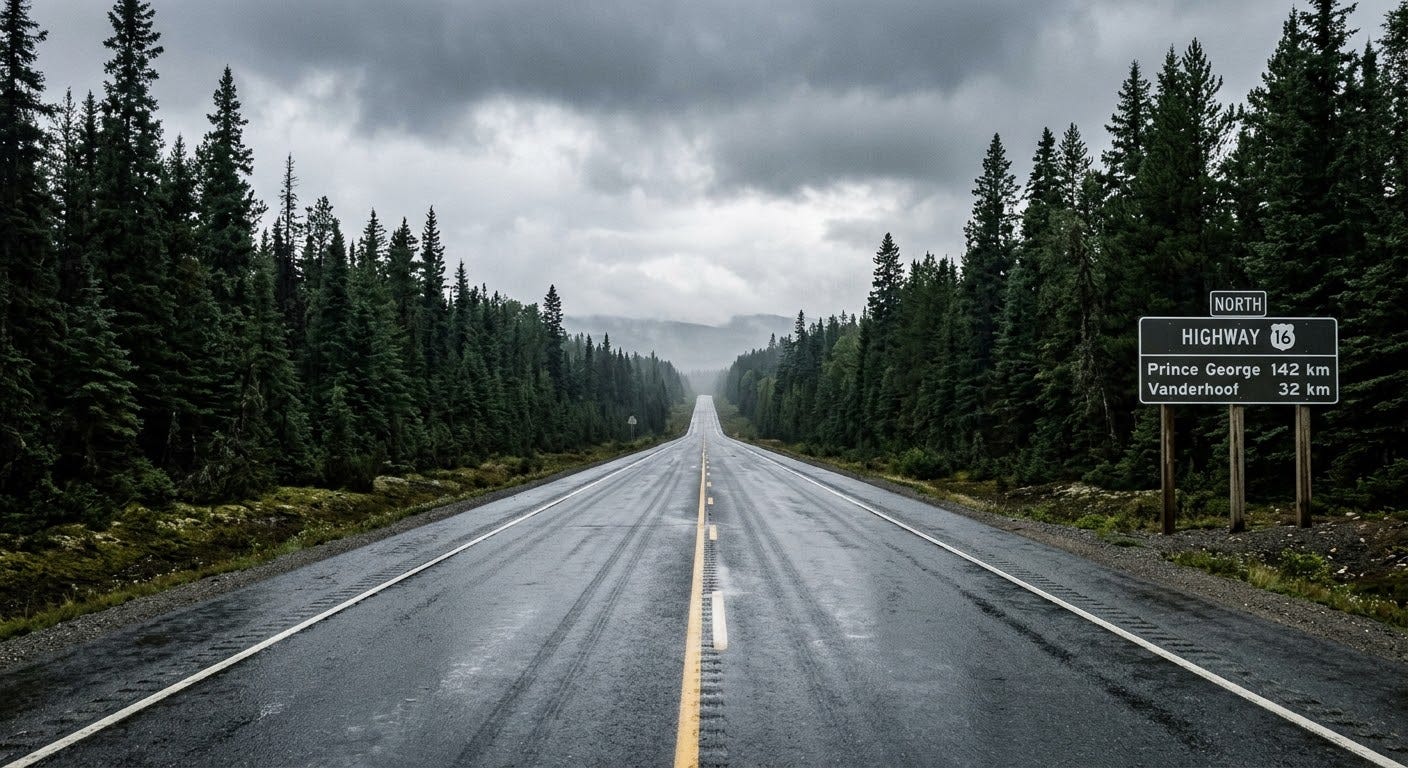
Highway 16, known as the Yellowhead Highway, is part of the Trans-Canada Highway system. The route runs from Masset on Haida Gwaii, British Columbia, in the west to Winnipeg, Manitoba, in the east; it is nicknamed the Highway of Tears.
Leaving the cities and towns behind, the view is breathtaking and vast, embodying the essence of wilderness. It has been described as the perfect place to go missing; the killer at the root of this story took full advantage of this remote landscape.
The murders started in 1969, and estimates suggest as many as thirty-three women have gone missing or been killed. Due to the vast size of the region, each disappearance was initially treated as an isolated incident rather than the work of one or more serial killers.
Systematic Racism
The murders are deeply tied to the lingering effects of colonialism, social injustice, and systemic poverty among First Nations communities. Because reliable public transport was non-existent along the corridor, hitchhiking became a necessary social norm.
Indigenous communities have faced not only the tragedy of loved ones vanishing or being found dead, but also callous indifference and institutional racism. When individuals vanished, the Royal Canadian Mounted Police (RCMP) frequently refused to investigate, dismissing concerns by telling relatives the victims had simply moved away to seek a better life.
Generational mistrust of law enforcement severely hindered investigations; First Nations families were accustomed to authority figures invading their homes, forcibly removing their children, and forbidding them from speaking their native languages. They were reluctant to talk to authorities.
Gloria Moody
The youngest victim on the list of eighteen women officially recognised by police is Monica Jack, a twelve-year-old who disappeared in 1978 while riding her bike home from a shopping trip. Her remains were discovered in 1995, twenty kilometres from her home.
Gloria Moody, aged twenty-six, is widely regarded as the first victim linked to the Highway of Tears cases. She was walking home from a pub in 1969 when her brother lost sight of her; he returned to his hotel room assuming she was safe. Less than twenty-four hours later, two hunters discovered her body ten kilometres away near Williams Lake. Gloria had been severely beaten and sexually assaulted; her clothing was recovered a short distance from the scene.
Three in One Year
Throughout the 1970s and 1980s, young women and teenagers continued to vanish along Highways 5, 16, and 97. In 1994, the rate of violence escalated dramatically.
Leah Germaine (15), Roxanne Thiara (15), and Ramona Wilson (16) were all murdered within a six-month window. This sudden concentration of deaths forced investigators to consider whether a serial killer was operating in the area, though institutional bias persisted.
Roxanne was a known sex worker struggling with addiction; she remained missing for a month before her body was discovered dumped beside Highway 16.
Ramona, by contrast, was a high school student who disappeared after hitchhiking to a local dance. In January 1995, the RCMP received an anonymous tip pinpointing a search location; police failed to locate her body at the time. Her remains were ultimately found in April, just a few kilometres from her home; she had been sexually assaulted and strangled.
Leah was found stabbed to death behind an elementary school; all three teenagers were killed in quick succession.
A Victim Worth Noticing
The ongoing tragedy finally captured widespread mainstream media attention when Nicole Hoar vanished in 2002. She was hitchhiking from a petrol station to visit her sister in Smithers; she was gainfully employed and scheduled to begin a master’s degree in the autumn. The national media took immediate notice.
A witness reported seeing Nicole at the petrol station; she had declined a lift from a man travelling with children because he was not heading all the way to her destination. She subsequently entered a yellow car driven by a white male aged between 20 and 35.
Because her trip was intended as a surprise, six days elapsed before family and friends raised the alarm. As a white, middle-class, non-Indigenous graduate, her disappearance generated an unprecedented level of press coverage.
The RCMP searched 24,000 square kilometres of terrain before scaling back ground operations after four days. Sustained media exposure brought renewed focus to the region, enabling Indigenous groups and advocacy organisations to highlight the dozens of previous victims; the investigation finally received significant resources.
The Investigation
When the three teenagers disappeared in 1994, an FBI profiler was consulted but concluded the cases were unlinked. By 2005, public awareness campaigns and solidarity marches forced a broader reassessment.
Ironically, during one of the largest solidarity walks on 17 September 2005, twenty-two-year-old Tamara Chipman vanished from the highway; she became another victim associated with the corridor.
In 2006, the RCMP established Project E-PANA to investigate the unsolved disappearances and murders along the highway network. Communication between First Nations leadership and law enforcement improved, and the task force expanded its scope from nine initial cases to eighteen.
Throughout its operation, Project E-PANA interviewed over 1,400 people of interest, collected 750 DNA profiles, administered 100 polygraph tests, and conducted 2,500 formal interviews. Despite this effort, the task force officially solved only two cases: the 1973 murder of Colleen MacMillen—linked via DNA to serial killer Bobby Jack Fowler—and the murder of Monica Jack.
By 2015, budget cuts, staffing reallocations, and organisational downsizing left Project E-PANA largely inactive, leaving families without resolution. Subsequent reviews revealed that key physical evidence and administrative records relating to the cases had been misplaced or lost.
Women and young girls continue to go missing along the corridor. Systemic failures and deeply embedded institutional racism failed vulnerable citizens; serial predators exploited these vulnerabilities with near-total impunity.
Be sure to check out our deep-dive article on Monday, where we examine the unsolved case of the I-70 killer.
Subscribe today: I spend hours digging through archives, old testimony, and forgotten files to bring these cases to life. Free posts are just the beginning, paid subscribers keep this work possible and get access to my full vault of articles.
If you’ve enjoyed this story and want to see more, please consider upgrading. It’s readers like you who keep Murder Mayhem UK alive.
Don’t want to commit then consider leaving me a tip if you enjoyed this article.
