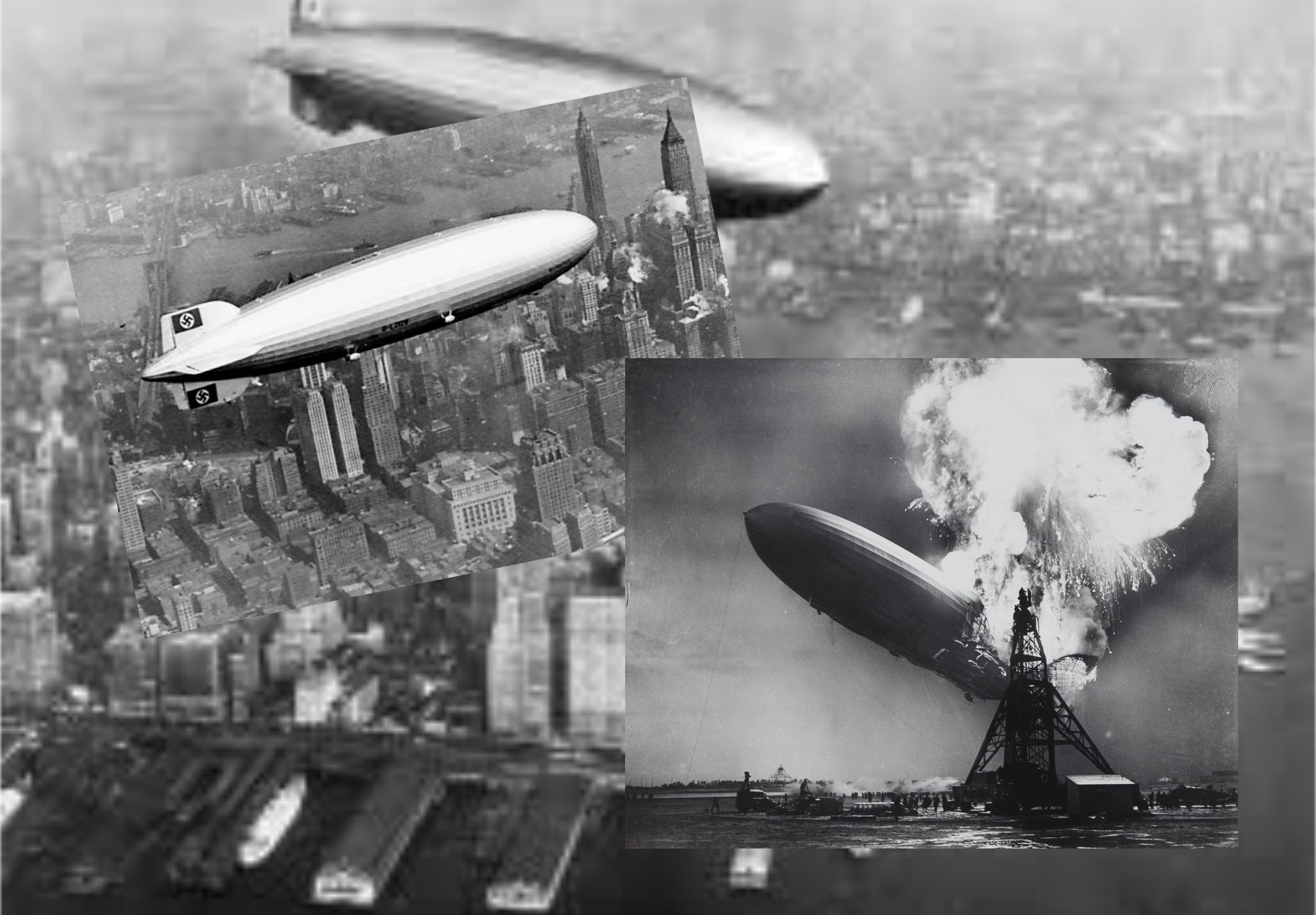
When the tragic accident happened with the Titan in 2023, I remember thinking to myself: what made these people get into what was nothing short of a bean tin to travel to the bottom of the ocean?
The truth is, we humans have been doing ill-thought-out ventures in the name of adventure for years. In 1937, people climbed into a tiny wooden carriage strapped to a ball of highly flammable gas to take to the skies. Like the Titan, their journey was not a successful one either. This is the story of the Hindenburg.
Early Zeppelins
Man has always had a dream of soaring like the birds and flying; this is what initially led to the invention of the hot air balloon by the Montgolfier brothers in 1782.
Count Ferdinand von Zeppelin took this concept further, creating rigid airships with aluminium frames that contained multiple gas bags containing hydrogen. The first Zeppelin was launched in 1900. Despite a range of early problems and failures, Hugo Eckener turned the Zeppelin into a commercial passenger vehicle by 1920.
The Hindenburg itself was a well-travelled Zeppelin before its tragic end. Photos exist of it floating above Rio de Janeiro, with Sugarloaf Mountain in the background.
The Hindenburg
The weather was clear and fairly settled on the 3rd May 1937 at 8 pm when the Hindenburg took off from Frankfurt, Germany. The ninety-seven people on board were bound for New Jersey.
The world’s largest airship, at an impressive 245 metres, was a marvel of its time. To give you perspective, its length was only slightly shorter than the Titanic. It was much larger than traditional aircraft such as the Boeing 747.
She was known as the “Queen of the Skies” and was the pride of Nazi Germany. The cabin, which hung beneath the main part of the ship, was unparalleled in luxury; it featured private sleeping rooms, a communal dining room, a lounge, and even a reading room.
The trip was not a cheap one. Tickets were $700—the equivalent of $7,000 today. It was a wealthy person’s vessel.
Disaster
The passengers had enjoyed a three-day journey when they finally arrived at Lakehurst Naval Air Station on 6th May. The weather conditions they left were now very unfavourable. As it descended to the airfield, the strong winds and overcast skies made navigation difficult.
Thousands stood on the airfield watching the world’s largest airship land. For three hours, the Hindenburg circled the landing field while the crews tried to level the ship for landing; dumping water ballast did nothing to help.
Finally, the landing lines were dropped to the ground crew below. That was when the passengers heard a sudden loud bang. The Hindenburg instantly became a flaming inferno. In just thirty-four seconds, the airship was engulfed in flames and collapsed in on itself.
As the airship crashed to the ground, ground crew and bystanders rushed into the heat and danger to try to pull the injured to safety.
The ensuing inferno, which took the lives of 13 passengers, 22 crew, and one person on the ground, was captured on cine film and memorably narrated by the newsreader, Herbert Morrison:
This is the worst of the worst catastrophes in the world! [...] There’s smoke, and there’s flames, now, and the frame is crashing to the ground [...] Oh, the humanity, and all the passengers screaming around here!
The footage had a massive impact, and images of the tragedy were shown around the world.
Theories
The tragedy led to its fair share of conspiracy theories. Had the voyage been sabotaged due to the tense political climate and who was onboard? Hugo Eckener, the head of the company that manufactured the Zeppelins, was a vocal critic of Adolf Hitler. Despite pressure to name the ship after Hitler, Eckener named it after the German president, Paul von Hindenburg. While some suspected Hitler or anti-Nazi activists of planting a bomb, investigations ruled this out.
If not human intervention, the next theory was focused on more “divine intervention”—natural causes. Had static electricity or lightning struck the vessel, causing it to ignite?
The leading theory now seems to point to a hydrogen leak combined with a spark of static electricity, which caused the highly volatile gas to catch alight. It was a mixture of poor design and a random spark.
Whatever the cause, the disaster had a profound effect on the public perception of airships. Helium, although non-flammable and a good alternative, was controlled by the United States, which had banned its export. Without a safer alternative, and with the advancements in reliable aeroplanes, the airship became a relic confined to history.
We Never Learn
Although airships have not been seen in our skies for decades, there is a modern interest in reviving them. Companies such as Hybrid Air Vehicles are testing new designs, such as the Airlander 10.
These modern airships will have the advantage of access to the safer helium; a leak on board would just result in the passengers speaking funny. The new airship could provide a sustainable travel option with fewer carbon emissions and less noise than traditional aeroplanes. It is estimated that commercial flights could return as early as 2030.
So, all that is left to ask is: would you go on one?
Be sure to check out our deep dive article on Monday where we look at the worst maritime disaster in US history.
Subscribe today: I spend hours digging through archives, old testimony, and forgotten files to bring these cases to life. Free posts are just the beginning, paid subscribers keep this work possible and get access to my full vault of articles.
If you’ve enjoyed this story and want to see more, please consider upgrading. It’s readers like you who keep Murder Mayhem UK alive.


"This is the worst of the worst catastrophes in the world! [...] There’s smoke, and there’s flames, now, and the frame is crashing to the ground [...] Oh, the humanity, and all the passengers screaming around here!"
"Oh, the humanity!" would go on to be one of the most cited (if only in comedic terms) phrases to ever have emerged out of American journalism, and a reputable summing-up of the human cost of technological innovation.