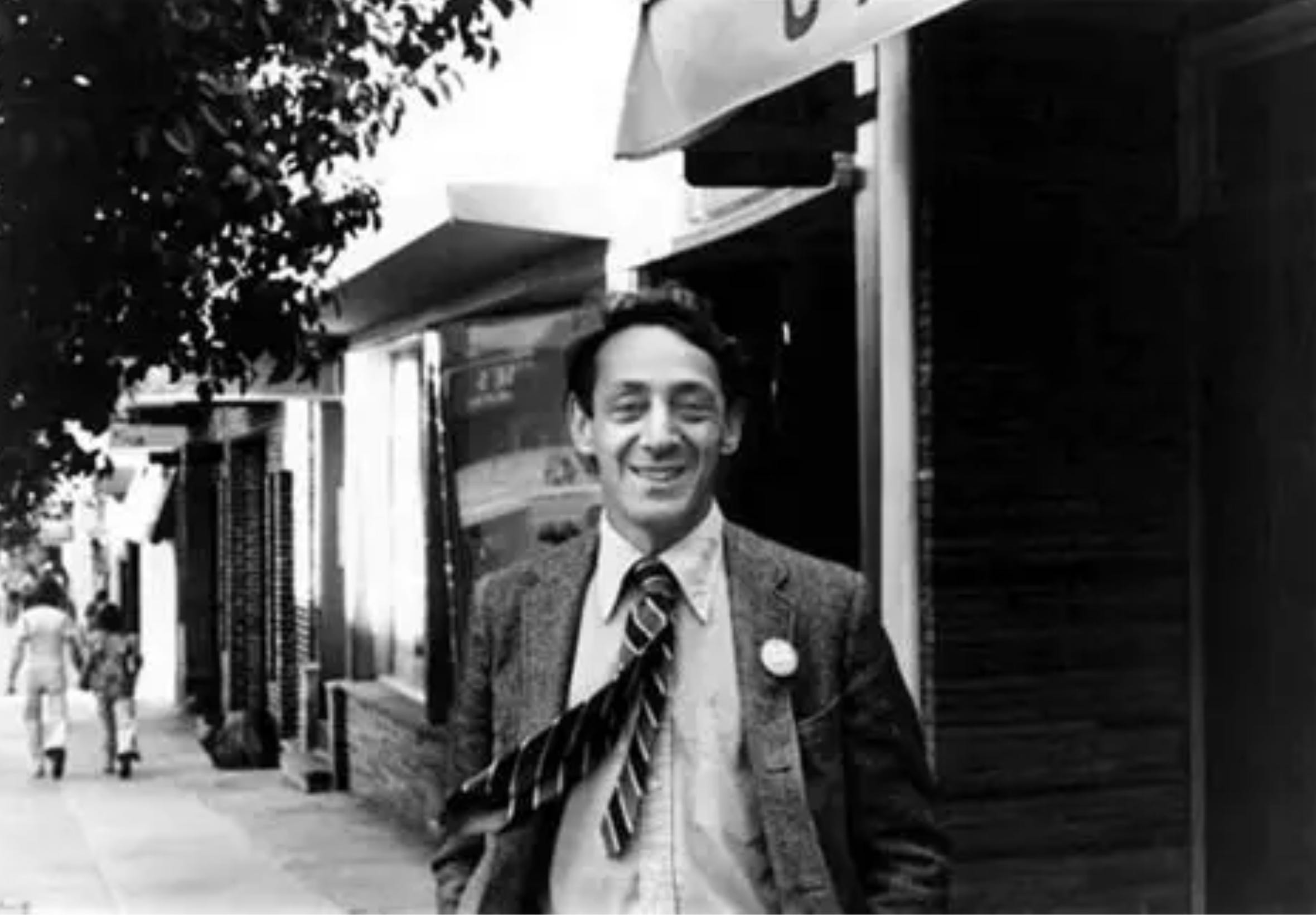
Harvey Milk was a trailblazing politician who became one of the first openly gay public officials in the United States and the first in California. During his rise, he showed society that gay people were involved in every facet of civic life, from taxes to the most mundane neighbourhood issues.
A New Kind of Representative
Milk made a name for himself as a fierce advocate for San Francisco’s LGBT community. However, his platform was broad; he championed low-cost housing, marginalised communities, and environmental issues. He was a man who took on any issue that affected others.
During his brief but impactful time as a city supervisor, he was instrumental in passing legislation that prohibited anti-gay discrimination in employment and housing in San Francisco.
His success was built on strategic alliances. In 1973, when the Teamsters Union struck against beer distributors, Milk saw an opportunity for solidarity. He helped organise a boycott of Coors in gay bars. Coors was one of the companies that specifically refused to sign union contracts. His idea was simple: if the gay community wanted others to help them fight discrimination, they had to help others in their fights.
Harvey was the closest thing the unions had to an ally, and so they, in turn, allied with him. This alliance with labour unions provided the political engine that eventually propelled him to victory in 1977. Friends were shocked to see him cut his long hair and adopt a look some would consider more “respectable” for the campaign.
An Unlikely Professional Bond
Once on the Board of Supervisors, Milk found himself sitting next to Dan White, a former police officer and firefighter with conservative, anti-gay views. Despite their differences, Milk insisted on finding common ground. He believed White’s prejudices stemmed from his Catholic upbringing, born of ignorance rather than malice.
By befriending White, Milk aimed to prove he was like any other man White might encounter. For a time, the pair forged an alliance based on mutual respect. Milk was even invited to the baptism of White’s child in 1977. White subsequently supported Milk when he championed the landmark anti-discrimination law. They worked together on the common ground of working-class issues, despite their vastly different opinions and life experiences.
The Conflict and the Resignation
The peace ended when White clashed with Milk and other members of the board. Struggling to support his family on a $9,600 salary (the equivalent of about $46,000 today), White resigned.
He soon attempted to rescind his resignation. However, progressive supervisors, including Milk, lobbied Mayor George Moscone to reject the move and appoint a more liberal successor. When a radio reporter tipped White off that the Mayor intended to follow through with the plan to replace him, the former supervisor decided to take violent action.
Tragedy at City Hall
On 27th November 1978, White arrived at City Hall with a .38-calibre revolver. He snuck through a basement window to avoid metal detectors and barged into Mayor Moscone’s office. After a brief talk, White shot Moscone four times—twice in the body and twice in the head.
While aides assumed the noise was a car backfiring, White sought out Milk and asked to speak in his old office. Once inside, White blocked the door with his body and shot Milk five times, including two point-blank shots to the skull. Within the hour, White turned himself in at his old police station.
A Shocking Verdict and the Aftermath
The trial that followed stunned the city. Because White was a former public servant and not a “wild-eyed lunatic,”the legal proceedings focused heavily on his mental state. He was eventually acquitted of murder and instead convicted of voluntary manslaughter. His sentence was just seven years.
His legal team argued that White suffered from “diminished capacity” due to severe depression. They used his sudden change in diet, from being a fitness enthusiast to consuming massive amounts of sugary junk food (like Twinkies), as clinical evidence that his mental state had deteriorated so significantly that he was incapable of the premeditation required for a first-degree murder conviction.
The lenient sentence sparked the “White Night Riots” in May 1979. Thousands marched on City Hall, burning police cars and resulting in 140 injuries. To many, justice had been flouted by the very system White once served. To others, the violence only deepened the city’s divisions.
The End of a Chapter
The tension of the riots was eventually followed by a quiet, sombre tribute. On what would have been Milk’s 49th birthday, 3,000 people gathered to sing and honour the dead supervisor in a peaceful rally.
Dan White served five years and one month before being paroled in 1984. He took his own life the following year. Harvey Milk’s legacy, however, remains a symbol of hope. He remains a proud pioneer in LGBT politics whose impact on public life continues to grow. He set the stage for many others to follow in his footsteps.
“I’m showing people here that gays are involved with taxes, and dog poop, and … everything else,” — Milk said in an interview with the Examiner a few months before the assassination.
Be sure to check out our deep dive on Monday covering the night San Francisco burned.
Until next Wednesday: Stay safe, stay curious.


-"...a city supervisor..." He was what would in other cities be called an alderman or city councillor for San Francisco, since, as you noted, they used Board of Supervisors in place of the usual City Council for their civic government.
-A film was later made about this story, starring Sean Penn as Milk. He won an Oscar for the role, as did the screenwriter.