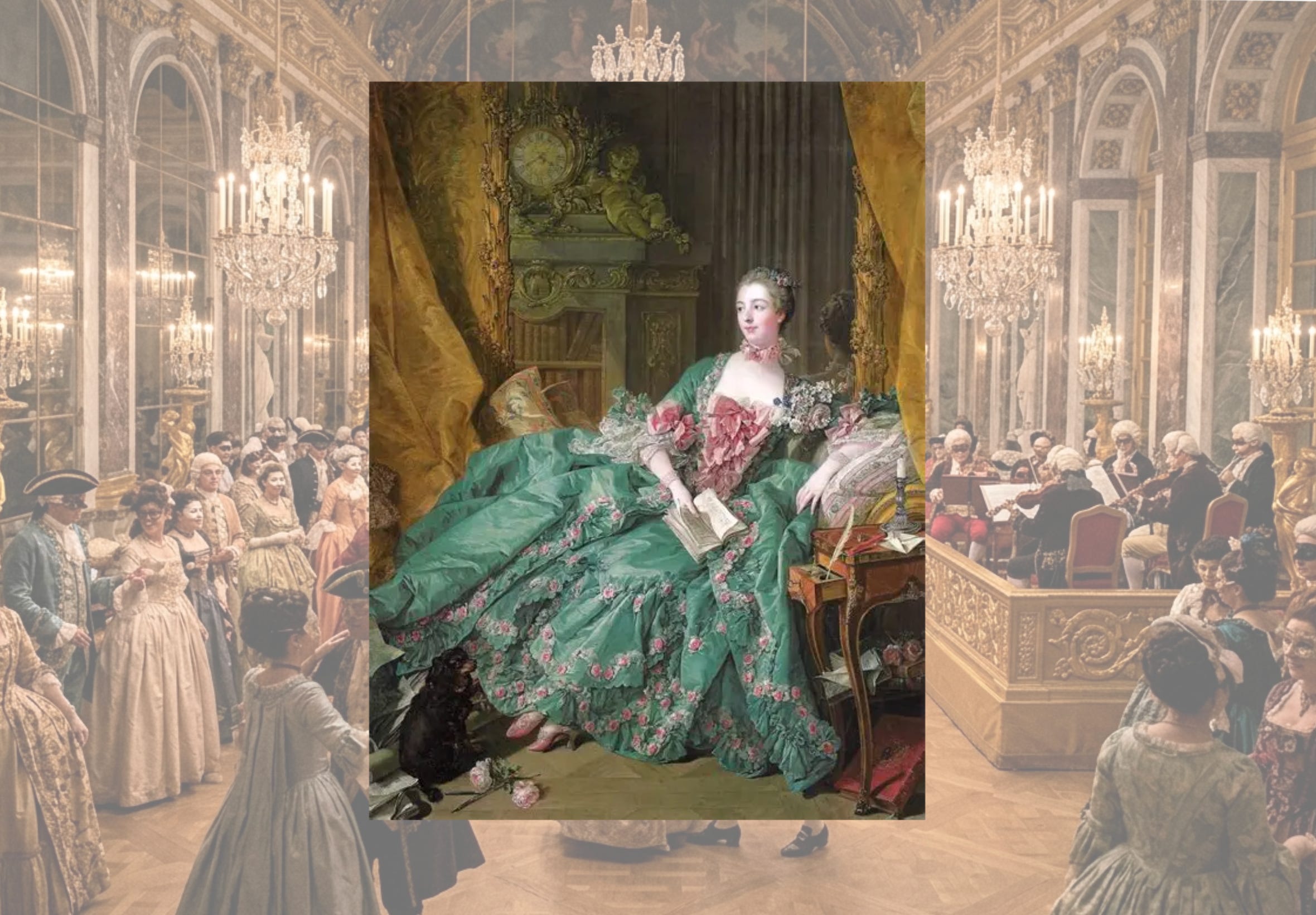
Jeanne-Antoinette Poisson was better known in history as the Marquise de Pompadour. She remains one of the most polarising and fascinating figures ever to grace the halls of Versailles. While the palace is now a museum for the modern masses, in the 18th century, it was a high-stakes arena of power and prestige.
Madame de Pompadour seemingly had it all: elegance, intelligence, and a refined beauty. Yet, she was a woman of complex layers. Ambitious and occasionally vindictive, she was nonetheless capable of profound kindness. She remained blindly devoted to her King, yet was astute enough to navigate the treacherous waters of French politics for two decades, a subject we will study further on Monday.
A Prophecy in the Making
Born on December 29, 1721, in Paris, scandal and serendipity marked Jeanne-Antoinette’s early life. Her father, François Poisson, fled the country in 1725 to escape execution for unpaid debts.
In his absence, the local fermier général (tax collector), Charles François Paul Le Normant de Tournehem, became the legal guardian of Jeanne-Antoinette and her brother, Abel-François. The arrangement was so close that many whispered de Tournehem was their biological father.
Precocious and beautiful, Jeanne-Antoinette was initially educated at the Ursuline convent in Poissy. However, her mother, Madeleine, eventually brought her home to personally oversee a specialised curriculum.
When Jeanne-Antoinette was just nine years old, her mother took her to a fortune-teller named Madame Lebon. The mystic famously predicted the girl would one day become “a morsel for a king.”
Madeleine took the prophecy to heart and spared no expense. Tutors were hired to teach her to paint, engrave, dance, and play the clavichord. She even memorised entire plays under the tutelage of renowned actors, an education specifically designed for a royal mistress-to-be.
Marriage and the Rise to Celebrity
At 19, Jeanne-Antoinette entered a marriage of convenience with de Tournehem’s nephew, Charles-Guillaume Le Normant d’Étiolles. It was a union of status. As a wedding gift, they received the estate of Étiolles, perfectly situated on the edge of the Royal Hunting Ground in the forest of Sénart.
While the marriage produced two children—a son who died in infancy and a daughter, Alexandrine, who tragically succumbed to peritonitis at age ten, it also provided the platform Jeanne-Antoinette needed.
As Madame d’Étiolles, she became a staple of fashionable Parisian circles. She founded her own salon, attracting the greatest minds of the Enlightenment, including her close friend Voltaire. As her celebrity grew, rumours of this brilliant woman reached the ears of King Louis XV.
The King
Louis XV was a man of sexual voracity and unflattering melancholy who had succeeded his great-grandfather at the age of five. By 1745, he was mourning his third official mistress.
On the night of February 25, 1745, during a masked ball at Versailles, he finally met the woman who would change his life: Jeanne-Antoinette. The ballroom was a sensory overload of heavy perfumes, beeswax candles, and the constant rustle of silk.
By March, she was his official mistress, installed in an apartment directly above his and connected by a secret staircase. By June, Louis purchased the Marquisate of Pompadour for her, elevating the commoner to a Marquise. Though her mother died that spring, never seeing the prophecy fully realised, Jeanne-Antoinette was formally introduced to the court on September 14, 1745.
She wasn’t just a pretty face. While she possessed a lovely complexion and elegant manners, it was her bright way of conversation that made her popular. She provided Louis with the confidence he lacked and created a delightful, curated life for him within the stifling atmosphere of the palace. She was even smart enough to build a relationship with his wife, who would speak favourably of the other woman.
Power Beyond the Bedroom
The physical romance was relatively short-lived. Due to fragile health and the strain of two miscarriages (in 1746 and 1749), their sexual relationship ended by 1751, when she was 30.
Remarkably, this did not diminish her power. If anything, the decade after they ceased to be lovers was the period of her greatest influence. She transitioned from lover to indispensable advisor. She coordinated everything from the King’s romantic interests to high-level foreign policy, most notably playing a key role in the Diplomatic Revolution of 1756, which aligned France with Austria. For nearly 20 years, she was the most powerful woman in France.
As well as political power, she became a cultural catalyst in Paris, turning the city into a place of taste and perfect architecture. She encouraged painters, writers, and thinkers such as Voltaire to make the city their home.
The Final Journey
In the winter of 1764, the Marquise contracted tuberculosis. She died on April 15 at the age of 42.
As her coffin was removed from Versailles in the pouring rain, a devastated Louis XV is said to have remarked:“La marquise n’aura pas de beau temps pour son voyage” (The marquise won’t have good weather for her journey).
Even her old friend Voltaire mourned her deeply, noting the absurdity of a beautiful woman, in the midst of a splendid career, dying while “ancient pen-pushers” lived on.
She was laid to rest at the Couvent des Capucines in Paris, leaving behind a legacy as a woman who was much more than a mistress; she was the heart of the French Enlightenment.
Be sure to check out our deep dive article on Monday, where we look at the political career of this amazing woman.
Until next Wednesday: Stay safe, stay curious.


What an interesting article. I can't even begin to imagine what it would have taken to navigate your way into a position of influence as a woman living in these times.