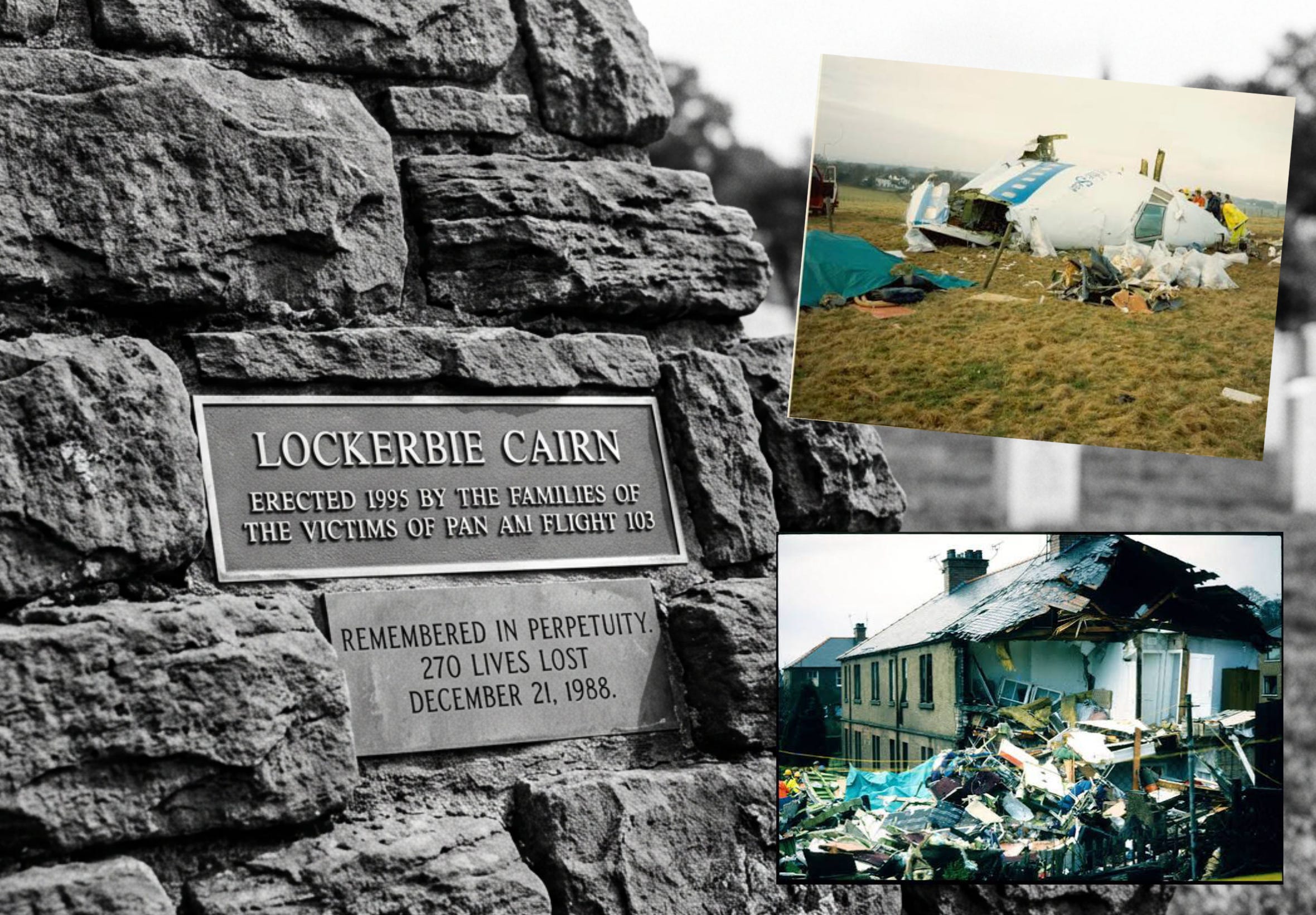
Just before Christmas in 1988, the United Kingdom became the target of one of the deadliest terrorist attacks in history. A bomb planted aboard Pan Am Flight 103 exploded over the small town of Lockerbie, Scotland, killing everyone on board and several residents on the ground.
The explosion scattered 300 tons of aircraft debris across an 845-square-mile area. Because the flight carried passengers from 21 nations, the majority of whom were American, the disaster triggered a massive, joint investigation between Scottish authorities and the FBI. Decades later, this cross-border case remains active, carrying far-reaching geopolitical implications.
The Fate of Pan Am Flight 103
The Boeing 747 took off from London Heathrow, bound for New York City. Just 38 minutes into the flight, as the aircraft reached its cruising altitude at 31,000 feet, the onboard explosive detonated. All 243 passengers and 16 crew members were killed instantly or during the descent, while the falling debris claimed another 11 lives on the ground.
Initial reports speculated a tragic accident, but forensic evidence quickly pointed to sabotage. Investigators determined that the blast caused the forward fuselage to disintegrate, tearing the nose section from the aircraft. The sudden decompression plunged the cabin into darkness and sub-zero temperatures.
Tragically, some passengers were caught in the engines or thrown clear during the breakup. However, the majority remained trapped within two large sections of the fuselage that plummeted to Earth. Experts believe up to 60 per cent of those on board survived the initial explosion, though it remains unknown how many remained conscious during the descent.
Devastation in Lockerbie
On the ground, the residents of Lockerbie were celebrating the festive season when a deafening roar shook the town. The impact of the main fuselage registered 1.6 on the Richter scale as aircraft remnants and victims rained from the sky.
The most catastrophic damage occurred on Sherwood Crescent, where the wings and mid-fuselage crashed into 21 homes, causing an explosion that left a 150-foot crater and killed 11 townspeople. First responders arrived at a scene of total devastation: fires burned across the town, and local senior policeman George Stubbs noted that the intense heat was powerful enough to melt wrought-iron gates.
Unravelling the Terrorist Plot
Piecing together the tragedy required Scottish and FBI investigators to analyse more than 10,000 pieces of evidence strewn across hundreds of miles. By July 1990, authorities officially confirmed that a Semtex bomb had destroyed the aircraft.
Forensics traced the blast to the forward cargo hold, where an explosive device had been concealed inside a radio cassette player packed into a brown Samsonite suitcase. Surrounding the blast site, investigators recovered scraps of clothing containing explosive residue, which were traced back to the Malta Trading Company.
Further investigation revealed that the suitcase had been routed from Luqa Airport in Malta onto Pan Am Flight 103. Investigators located the Maltese shopkeeper who sold the clothing; he vividly recalled a Libyan customer who purchased the items without checking their size or price.
The Libyan Connection
The suspect was identified as Libyan intelligence officer Abdel Basset Ali al-Megrahi. He had conspired with Abu Agila Mohammad Mas’ud Kheir Al-Marimi and Lamen Khalifa Fhimah.
Interrogations later revealed that Megrahi instructed Mas’ud to set the bomb’s timer for 11 hours. After placing the rigged cassette player into the suitcase, they checked it onto a conveyor belt at Luqa Airport. Mas’ud then boarded a flight to Tripoli, where the co-conspirators later met with senior Libyan intelligence officials to brief them on the operation. Three months later, Libyan leader Muammar Qaddafi personally met with Mas’ud and Fhimah, praising them for completing a “national duty” against the United States.
In 1991, Megrahi and Fhimah were indicted on 270 counts of murder and conspiracy, alongside violations of Britain’s 1982 Aviation Security Act. After years of diplomatic talks, the suspects were finally extradited to the Netherlands in 1999 to face trial in Scotland.
Trial, Justice, and Geopolitical Revenge
The trial commenced on May 3, 2000. Megrahi was found guilty and sentenced to 27 years in prison, while Fhimah was acquitted. Neither man ever admitted a role in the bombing.
Investigators concluded the attack was a state-sponsored act of retaliation. Libya sought revenge for a 1986 U.S. airstrike on Tripoli that killed Qaddafi’s young daughter. Analysts also suggest it may have been tied to retaliation for the U.S. Navy’s accidental downing of Iran Air Flight 655 earlier in 1988, which killed 290 civilians.
In 2009, Megrahi was released from a Scottish prison on compassionate grounds following a terminal prostate cancer diagnosis, a decision that drew sharp criticism from U.S. officials and victims’ families. He died in Libya three years later, in 2012.
The Pursuit of Justice Continues
The Lockerbie case did not close with Megrahi’s death. On December 21, 2020, the 32nd anniversary of the attack, the U.S. Department of Justice announced criminal charges against the bomb-maker, Abu Agila Mohammad Mas’ud Kheir Al-Marimi.
In 2022, Mas’ud was taken into U.S. custody to stand trial, where he faces a potential life sentence. For the families of the 270 victims, the pursuit of full accountability continues. The court case is due to be heard this year, and preliminary proceedings took place in May 2026.
Today, the victims of Pan Am Flight 103 are memorialised at Arlington National Cemetery in Washington, D.C., by a traditional Scottish cairn constructed from 270 individual Scottish stones. The monument stands as a permanent reminder of the lives lost in this tragedy, bearing an inscription that ensures their memory will never be forgotten:
On 21 December 1988, a terrorist bomb destroyed Pan American Airlines Flight 103 over Lockerbie, Scotland, killing all on board and 11 on the ground. The 270 Scottish stones which compose this memorial cairn commemorate those who lost their lives in this attack against America.
Be sure to check out our deep dive article on Monday, where we look at another historical air crash that changed history.


