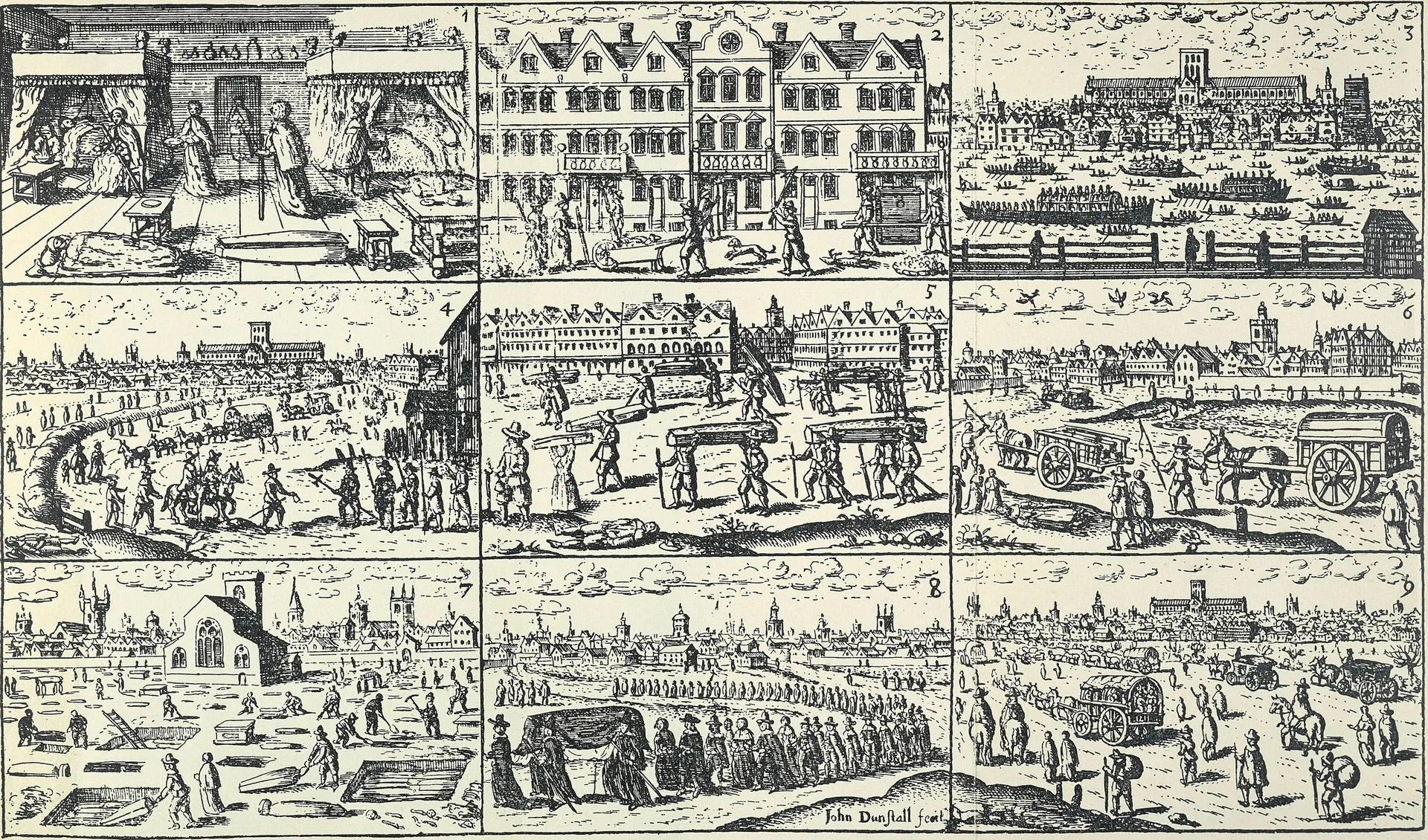
At the moment, where I live, we have an unprecedented number of meningitis cases. It is all anyone talks about. The anxiety hangs heavy in the air, making it easy to imagine what it must have been like 360 years ago when you walked past a door and saw that jagged red cross slashed across it.
The Great Plague of 1665 remains the most devastating outbreak of disease in London’s history - only the Black Death in 1348 rivals it for its death toll. While official reports say the plague claimed 68,596 lives, historians believe the true toll likely exceeded 100,000, roughly 15% of London’s population. This catastrophe reshaped the social, economic, and political landscape of 17th-century Britain, leaving a scar on the city that would never fully fade.
What is the Plague?
The Plague is an infectious disease caused by the bacterium Yersinia pestis. In 1665, it manifested in three terrifying forms, each more dangerous than the last. The most common was the Bubonic Plague, which forced painful, walnut-sized swellings (buboes) to sprout in the lymph nodes of the neck, armpit, and groin. Victims endured splitting headaches, violent vomiting, and high fevers, with those who contracted it facing a 30% chance of dying within two weeks.
Even more terrifying was the Pneumonic Plague, a lethal airborne version that attacked the lungs and spread through the wet spray of coughing and sneezing, causing the contagion rate to skyrocket.
Finally, the Septicaemic Plague represented the rarest and deadliest form; this occurred when bacteria invaded the bloodstream directly, leaving almost no hope of survival. Despite the clinical reality we know today, 17th-century Londoners remained trapped in a world where the biological cause was entirely unknown.
Rats and Rumours
Panic sparked a wave of desperate theories regarding the cause of the pestilence. To ward off the “miasma” or bad air, Londoners stuffed their pockets with pungent herbs, wore necklaces of dried toads, and applied strange poultices to their skin. In the narrow, darkened streets, the air thick with the smell of vinegar and woodsmoke, the infected would hug birds, apply leeches, or even swallow poison in a frantic attempt to find a cure.
We now know that black rats drove the outbreak, carrying fleas that harboured the bacteria. The filth of London’s slums lured these rats by the thousands, especially in the poorer areas, creating a reservoir for the disease to simmer before boiling over into the rest of the city.
A Timeline of Terror
Much of what we know about the plague, and how it took London in its grip, comes from the diary of a Navy official, Samuel Pepys. While Pepys wrote to process his own feelings, much like many of us do today, he inadvertently produced one of the greatest historical records of the era. The disease broke out in the spring of 1665 in St Giles-in-the-Fields, a parish just outside the city walls. By April, the scratch of Pepys’s pen recorded his growing dread as he observed houses being shut up and marked for death.
The summer of 1665 arrived as one of the hottest on record. As the heat intensified, so did the mortality rate, with four hundred and seventy deaths per week recorded in June. That number exploded to two thousand a week in July, yet the worst was still to come. In a single week in September, the epidemic claimed 7,165 lives, turning the city into a silent graveyard.
A Disease of Class
The plague did not strike everyone equally; wealth dictated who lived and who died. Those with the means to flee abandoned the city, including King Charles II and Sir Isaac Newton. While Newton sheltered at Woolsthorpe Manor, he famously watched an apple fall, an event that sparked his theory of gravity.
As the elite fled, the infrastructure of the city crumbled. Parliament postponed its sessions and retreated to Oxford, while lawyers, merchants, and the nobility soon followed. Even the medical profession fractured; out of seventy-nine doctors within the city, only three remained to care for the poor.
Meanwhile, those in the slums found themselves trapped. The poor were beaten back from the countryside if they tried to escape, dying in their thousands with no way out. For the impoverished, there was no escape from the encroaching shadow.
Life Under Lock and Key
If one family member fell ill, authorities nailed the entire household shut for forty days and painted a red cross on the door. This silent death sentence often forced the healthy to wait in the dark until they caught the disease from the sick. A watchman stood guard outside to prevent escape, but while his role was to provide food, many watchmen fell ill themselves, leaving the families inside to face the slow agony of starvation.
Through the night, the heavy wheels of the “dead carts” rattled over the cobblestones as the cry of “bring out your dead” echoed through the streets. Rotting corpses were loaded up for mass graves, and because so many doctors had fled, “searchers” were hired to identify the bodies.
The sheer volume of the dead was so overwhelming that many historians today still question the accuracy of the official records. The plague eventually strangled the British economy; trade ceased entirely and London was closed for business. As the watermen and domestic servants lost their livelihoods, those who didn’t die in agony were left to starve.
The End of the Epidemic
Contrary to popular myth, the Great Fire of London did not end the plague. By the winter of 1665, the arrival of colder weather naturally began to slow the disease. Natural herd immunity also took hold as survivors developed a stronger resistance.
Interestingly, it wasn’t just humans who adapted; black rats began to live with the disease rather than dying from it, meaning fewer fleas jumped to human hosts. Additionally, the shuttering of the ports provided an effective, if brutal, quarantine against new waves of infection.
By February 1666, London began the long road to recovery, though the plague lingered in surrounding areas like Deptford and Colchester. After 1666, Britain never saw another outbreak on this scale, but the memory of the red cross would haunt the national psyche for centuries.
Be sure to check out our deep-dive article on Monday. We will look at another incident that claimed the lives of Londoners, but this one did not respect class or wealth.
Until next Wednesday: Stay safe, stay curious.


