

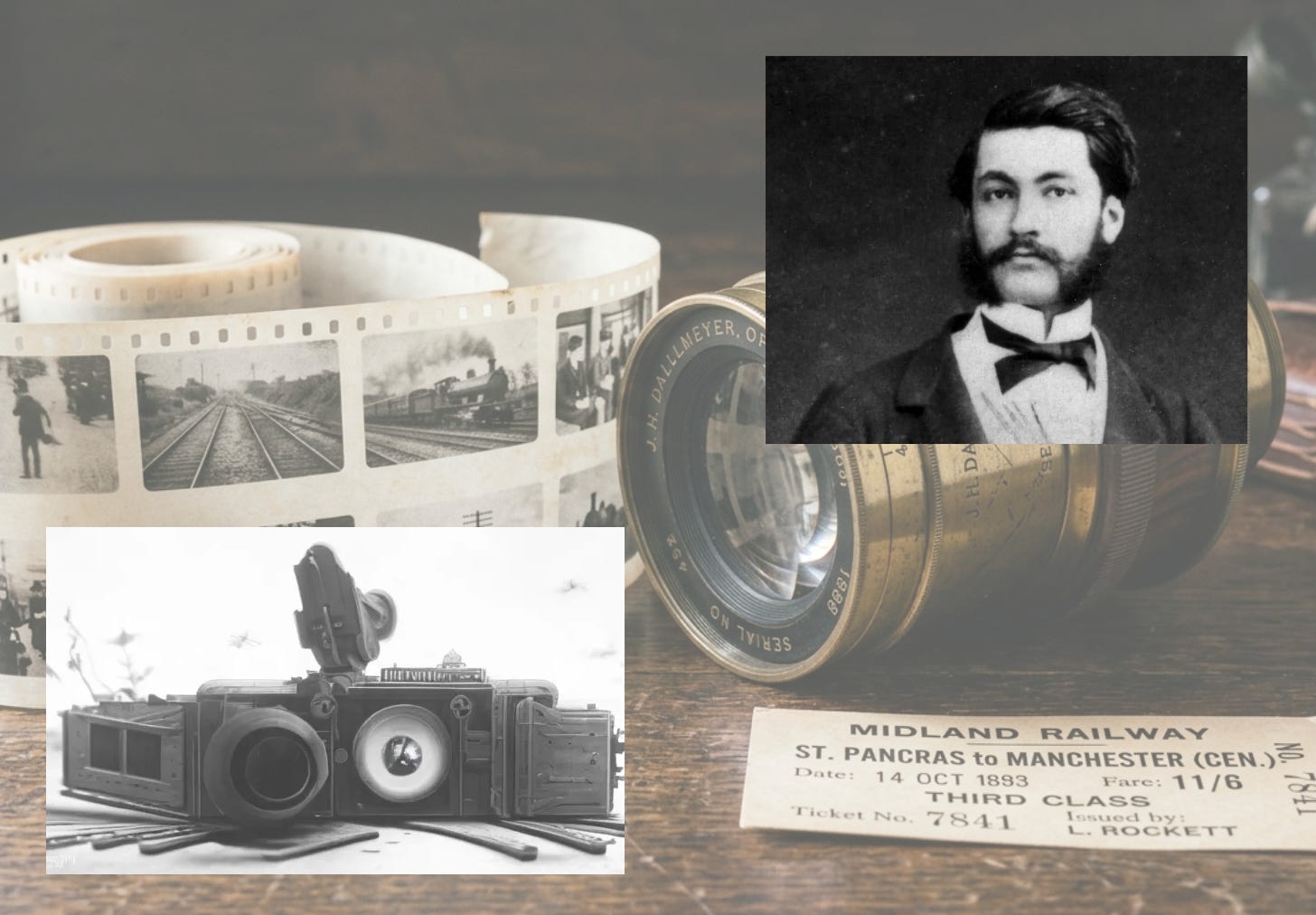
One of the greatest mysteries in cinema history did not take place on the big screen; instead, it was the story of the cameras that filmed the first motion pictures. The story has everything you would expect of considerable screen suspense: intrigue, drama, and even possible murder.
Louis Aimé Augustin Le Prince is credited as the Father of Cinematography and the inventor of motion pictures. However, it was not always this way; for years, no one knew Le Prince’s name, mainly because the man himself disappeared without a trace.
Some have argued that he committed suicide, unable to deal with the pressure his invention brought about. Others state that the incident is far more sinister and that he was murdered by one of his rivals.
Louis Le Prince
Le Prince was a French artist born in 1841 in Metz, France. His father was a major in the French army. During his childhood, his father’s friend, Louis Daguerre, who invented the daguerreotype, taught the young Le Prince photography and chemistry.
This passion followed him into adulthood, where he studied painting and chemistry in Paris and Leipzig. Having finished his university education, he moved to England. In 1869, he married Elizabeth Whitley, a talented artist.
The couple established the Leeds Technical School of Art, an applied art school. The college became a household name when they started fixing colour photographs to metal and pottery.
It wasn’t long before their work became so well respected that they were commissioned by Queen Victoria and Prime Minister William Gladstone to paint portraits.
Le Prince also liked experimenting with technology and looking for new ways to improve art. He became the first to make a working model capturing motion pictures.
He achieved this breakthrough at his workshop in Leeds.
One month before he was due to reveal his invention to the world, he disappeared.
The First Motion Picture Camera
In the 1880s, Le Prince became interested in cinematic technologies. He started by creating a sixteen-lens camera, applying for a US patent and receiving it in 1888. He built the apparatus in his workshop in Leeds.
On 14th October 1888, he recorded the Roundhay Garden Scene, capturing four family members walking in a garden. On the same day, he filmed a separate sequence featuring his son Adolphe playing the accordion. Both sequences were filmed using an improved single-lens camera.
Both Thomas Edison and the Lumière brothers have dominated the headlines for inventing equipment which made moving images possible. However, evidence shows that Le Prince preceded their inventions by several years.
The machine that Le Prince designed utilised paper-backed strip film to capture moving pictures. Although relatively primitive by today’s standards, his machine essentially started modern cinema.
Missing
Le Prince, having secured his patents, was preparing to travel to the US to publicly unveil his invention. Before travelling to America, though, he returned to France to visit his brother in Dijon.
He took a later train to Paris, missing his scheduled meeting with friends in the city. He was never seen again. His brother at the Dijon station was the last person to see Le Prince alive.
Both the French police and Scotland Yard took on extensive searches. The family also followed their own lines of enquiry. Unfortunately, all efforts were in vain, as he was never found.
Theories
With any disappearance without clear answers, theories abound, though none have been substantiated. The main theory strenuously believed by his wife, Elizabeth Whitley, was that Le Prince was assassinated by Edison or an accomplice as part of an aggressive patent war.
Others suggested he disappeared on the orders of his family and died in Chicago in 1898, claiming his family persuaded him to vanish after discovering he was gay.
In 1890, a drowned man was pulled out of the Seine, bearing a striking resemblance to Le Prince. However, this photo only came to light in 2003 when it was rediscovered in the Paris Police archives.
People have since speculated that he took his own life after failing to get his projector working perfectly and being overwhelmed with debt. Others have claimed the man pulled from the river was far too short to be Le Prince.
Patent War
In 1894, Edison was credited as the US inventor of motion pictures. The Lumiere Brothers were credited in France. They hosted the first commercial exhibition of motion picture films in 1895
Le Prince was declared legally dead in 1898. Shortly after, his elder son Adolphe was called as a key witness in litigation against Edison brought by the American Mutoscope Company.
The court case was unsuccessful in establishing Le Prince’s commercial priority, and in a tragic twist, Adolphe was found dead in New York in 1901. Many years later, Le Prince was finally recognised for his true contributions to motion pictures.
Whether his disappearance was an accident, an assassination, or something else, no one will ever know for certain. Nevertheless, the mystery of Louis Le Prince’s disappearance fascinates historians to this day.
Be sure to check out our deep dive article on Monday, where we look at another young inventor - this one much more dangerous.