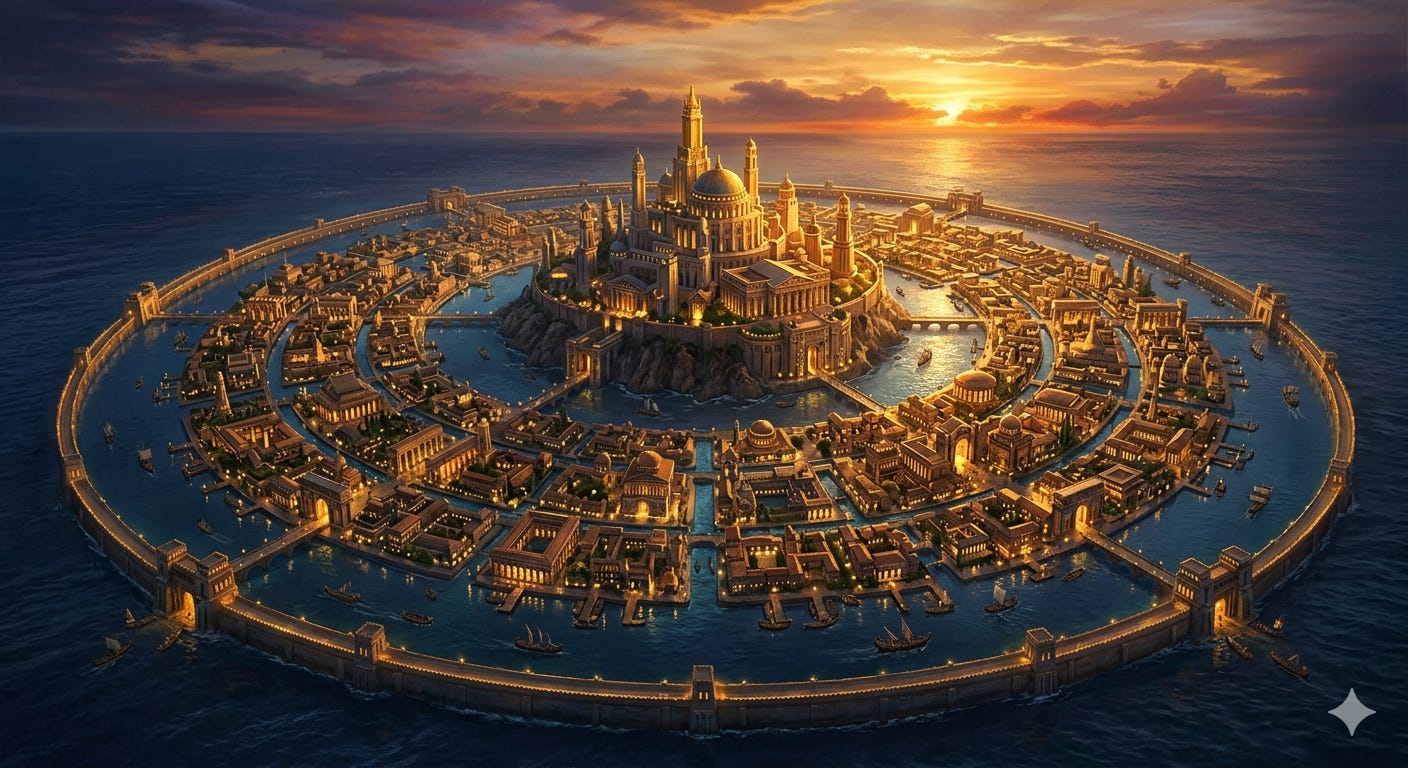
Some great thinkers considered Atlantis a fictional island Plato had made up to teach philosophy, whilst others consider that he based it on a real place lost to history. There are even mentions of it in some CIA files. So, what is the truth about the mystical city that disappeared?
Plato
Plato wrote about Atlantis, describing the island as one of the most powerful naval empires known. He states that they dominated much of the Western world. However, when they angered the gods due to their immoral living, the gods submerged them in the Atlantic Ocean.
Historians have now stated they believe Plato’s description was purely fictitious. He used the imaginary city to illustrate his larger points of view in works such as Timaeus.
Many great and wonderful deeds are recorded of your state [Athens] in our [the Egyptian’s] histories. But one of them exceeds all the rest in greatness and valour. For these histories tell of a mighty power [Atlantis] which unprovoked made an expedition against the whole of Europe and Asia, and to which your city put an end. — Plato, Timaeus 24e - 25d
Plato said it existed about 9,000 years before his own time, and that poets, priests, and others had passed down its story. But Plato’s writings about Atlantis are not the only known records of its existence. Other mentions of Atlantis include Greek texts which used the term to describe those who lived near the Atlas Mountains.
Atlantis
The island from 360 BC is described as larger than Libya and Asia and was situated in the Strait of Gibraltar. This set of islands in the Atlantic Ocean was separated by wide moats and linked by canals that penetrated to the centre. The islands were circular in nature, looking like a large labyrinth.
The founders of the island were said to be half-god and half-human. The lush islands contained gold, silver, and other precious metals and supported an abundance of rare, exotic wildlife. There was a great capital city on the central island, where a palace was built for Poseidon’s mortal wife, Cleito.
On the island was a great empire that ruled over several other parts of the continent. They were a vast power that endeavoured to subdue many other countries. Illustrations of the area show a utopian scene on the cover with mythical animals. Was this the home of unicorns and dragons?
The men of Atlantis were said to have no competition when it came to courage and military skill, and they were led by great men. There were no invaders who triumphed over them. The island was protected by the god of the sea, Poseidon, who became angry with the conduct of its people.
On one single day and night, the island was ravaged by violent earthquakes and floods and it sank into the earth, disappearing into the sea. The sea in that area then became impassable and impenetrable because of the shoal of mud that was caused by the submergence of the island.
What is the truth?
Likely, the island of Atlantis never existed; it seems hard to imagine we would not have discovered some sign of it by now if it did. But Plato’s fascination with the island sparks many questions. Would he write about a completely fictitious city? It seems unlikely.
Many historians and ocean explorers state that it simply does not exist. Pick a spot on a map and people have said this was where Atlantis was.
Some say it is a misconception from another tragedy. About 3,600 years ago, a massive volcanic eruption devastated the island of Santorini in the Aegean Sea near Greece. At the time, the advanced society of the Minoan civilisation disappeared. Some have stated that this could have been Atlantis.
However, there are some that state that this is another example of Root Races.
Root Races
This is the idea that progression is not linear; our existence has not gone from primitive to advanced but rather consists of repeated cycles of the rising of civilisation to destruction, only for the concept to start again.
Atlantis and Lemuria have been noted as the first of the root races. Each race has a specific evolutionary goal; once the civilisation reaches that, a global event happens, removing this group. A very small number of the citizens escaped to form the next civilisation; in this case, Egypt and Mesoamerica. This would explain how the knowledge to build the pyramids was obtained.
It is a theory that could point to the fact that this current civilisation has regressed significantly when we look at the Earth. The Atlanteans left nothing behind when they left—no buildings and no effect on the Earth. The Egyptians left stone pyramids which, although visible, have caused little harm to the planet. Can we say the same?
We would leave vast quantities of plastics and rubbish on a planet we have all but destroyed. Maybe civilisations are not evolving but regressing.
Whichever version of history you believe, Atlantis is a tale that has endured for centuries. It endures because it is a tale of god-like creatures, opulence, and fallen men.
“It’s a story that captures the imagination,” says James Romm, a professor of classics at Bard College in Annandale, New York. “It’s a great myth. It has a lot of elements that people love to fantasize about.”
If you loved this deep dive into an ancient civilisation, be sure to check out our deep-dive article on Monday, where we look at the library of Alexandria and the myth behind the fire that destroyed it. Could Alexandria have contained the proof of Atlantis?
Subscribe today: I spend hours digging through archives, old testimony, and forgotten files to bring these cases to life. Free posts are just the beginning, paid subscribers keep this work possible and get access to my full vault of articles.
If you’ve enjoyed this story and want to see more, please consider upgrading. It’s readers like you who keep Murder Mayhem UK alive.


