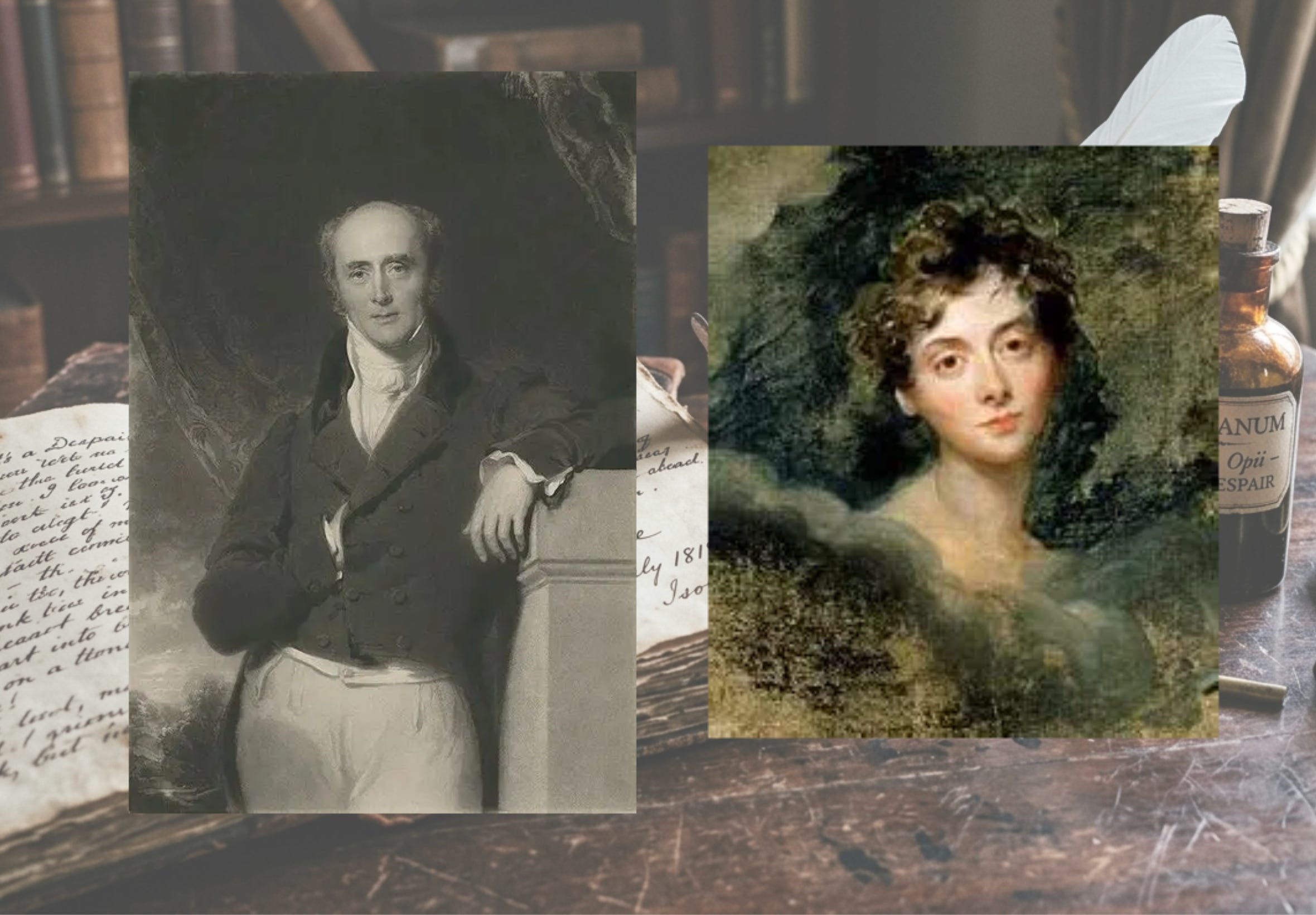
When Queen Victoria came to the throne, she was a naive girl. Her mother had shielded her entirely from the harsh realities of life. Her first Prime Minister was Lord Melbourne, a man with whom she quickly developed an incredibly close relationship.
The bond they shared bears a great resemblance to the later pairing of Queen Elizabeth II and Winston Churchill. Melbourne was Victoria’s friend, confidant, and trusted advisor. Both young queens relied heavily on their first Prime Ministers to navigate the pressures of the crown.
Lord Melbourne helped shape the monarch that Victoria would eventually become. Naturally, this intrigued me. I wanted to look deeper into his past. I already knew from various biographies of the young queen that Melbourne was a widower who had tragically lost his son.
What I did not expect to find as I dug into his domestic life was a story completely dominated by his wife. She was arguably even more fascinating than he was. Furthermore, she possessed a strange, tentative connection to one of my absolute favourite books: Frankenstein.
This is the story of Lady Caroline Lamb, the woman who would marry into the Melbourne title; a soul never content with life.
Lady Caroline
Caroline was born on 13th November 1785. She was the only child of Frederick Ponsonby, the 3rd Earl of Bessborough, and Henrietta Spencer. Their marriage was notoriously unhappy. This fractured domestic environment probably shaped Caroline’s unique, unpredictable personality.
From her earliest years, Caroline refused to be conventional. Peers described her as volatile, intense, and deeply temperamental. She defied the strict gender boundaries of her era, routinely wearing trousers and riding horses bareback across open fields.
In 1802, she debuted to high society’s prospective bachelors. The elite nicknamed her the “Fairy Queen”. It was during this season that she caught the eye of William Lamb, the man we know today as Lord Melbourne. Unfortunately, William was only a second son at the time. Lacking status and fortune, he was not permitted to propose. Then, fate intervened.
William Lamb
When William’s elder brother, Peniston, died unexpectedly, William’s financial and social stature increased overnight. He was now the heir. At the end of the traditional period of mourning, he proposed to Caroline, and the couple were wed on 3rd June 1805.
Their marriage was never destined to be smooth sailing. The chaos began at the wedding itself. Caroline threw a violent temper tantrum at the reception, forcing staff to escort her away from her own guests.
The couple would go on to have one son, Augustus, who survived infancy. Augustus was born with severe learning difficulties; mentally, he never progressed past the age of a seven-year-old. He passed away in 1836 at the age of twenty-nine.
Long before his death, however, the marriage had eroded. Records show the couple were living largely separate lives as early as 1810.
Lord Byron
For those who know the history of Gothic literature, Lord Byron was the infamous poet staying near Mary Shelley in Switzerland when she conceived Frankenstein. Byron was a man who cared nothing for the sanctity of marriage. He found it incredibly easy to draw the restless Caroline into a passionate affair.
Byron was not Caroline’s first extramarital indiscretion. That title belonged to Sir Godfrey Webster, though that brief liaison lacked the consuming fire of her next relationship. During her time with Byron, the couple went so far as to perform a mock marriage ceremony. Caroline completely committed herself to the poet, conveniently ignoring the fact that she already had a husband.
When Caroline first met Byron, he had just become an overnight celebrity following the publication of Childe Harold in 1812. She pursued him relentlessly. While Byron initially revelled in the intense attention, he quickly grew exhausted by her obsessive, public behaviour. The advice of an unusual confidante compounded his exhaustion.
The End of the Affair
In a strange twist of history, Byron was intimate friends with William’s mother, Elizabeth, the Lady Melbourne of that era. Operating with a distinctly cynical view of marriage during the late Georgian period, Elizabeth’s own life was scandalous; rumours persist regarding the true paternity of her children. Regardless of her own morals, she conspired directly with Byron to end his affair with her daughter-in-law.
You might assume she did this to protect her son William, who had chosen to wait out the scandal. You would be wrong. Many historians believe she broke up the affair purely so she could take Caroline’s place in Byron’s bed.
Whatever the ultimate truth, the rejection devastated Caroline. Her mental health spiralled into a dangerous decline. She became utterly consumed by Byron, tracking him down at his London rooms and bombarding him with frantic letters.
On 5th July 1813, she encountered Byron at a high-society ball for the first time since the breakup. Overwrought with emotion, she picked up a broken glass bottle and publicly slashed her own arms. Polite society was horrified by the display and promptly shunned her.
Novelist
Following this highly public breakdown, family members suggested she be sent away to the countryside to recover. Instead, Caroline played one final, dramatic card: she wrote a scandalous novel based entirely on her affair with Byron, titled Glenarvon.
Published anonymously in 1816, Glenarvon became an immediate bestseller.
It did not take long for high society to decode the characters and identify the author. Outraged by the exposure, the aristocracy completely cast her out. No one would associate with her, except for William. Remarkably, her husband stood faithfully by her through the entire social ruin.
Till Death Us Do Part
When news reached Caroline in 1824 that Byron had died in Greece, she collapsed into a hysterical fever. She smashed furniture in her grief and galloped wildly on horseback through the family park. Doctors resorted to heavy doses of laudanum and brandy to quiet her frayed nerves. Through it all, William remained at her side, caring for her.
Ultimately, her volatile behaviour took an unsustainable toll on William’s peace and his rising political career. The couple officially separated in 1825. William left Caroline behind at the country estate while he relocated to London to focus on parliament.
As the years advanced, Caroline grew noticeably calmer. Observers noted that she finally seemed to develop a genuine, quiet fondness for her husband. In October 1827, her health failed as she developed severe dropsy.
In January 1828, realising the end was near, she sent for William. He rushed to her side, and she passed away with him present on the 26th of January. Her official cause of death was severe oedema, brought on by years of heavy self-medication and chronic alcoholism.
William Lamb went on to inherit the title of Lord Melbourne, eventually becoming Prime Minister and the young Queen Victoria’s closest mentor. He died on 24th November 1848 at his family home, following a painful physical decline after a major stroke.
He spent his final years isolated at Brocket Hall, largely forgotten by the political world and cut off from Queen Victoria; a lonely retirement that deeply saddened him.
Be sure to check out our deep dive article on Monday, where we look at another famous Victorian woman that the monarchy never wanted spoken about - Mary Ann Brough
Subscribe today: I spend hours digging through archives, old testimony, and forgotten files to bring these cases to life. Free posts are just the beginning, paid subscribers keep this work possible and get access to my full vault of articles.
If you’ve enjoyed this story and want to see more, please consider upgrading. It’s readers like you who keep Murder Mayhem UK alive.


I suspect that he, or a relation, is the person for whom Melbourne, Australia, was named.