

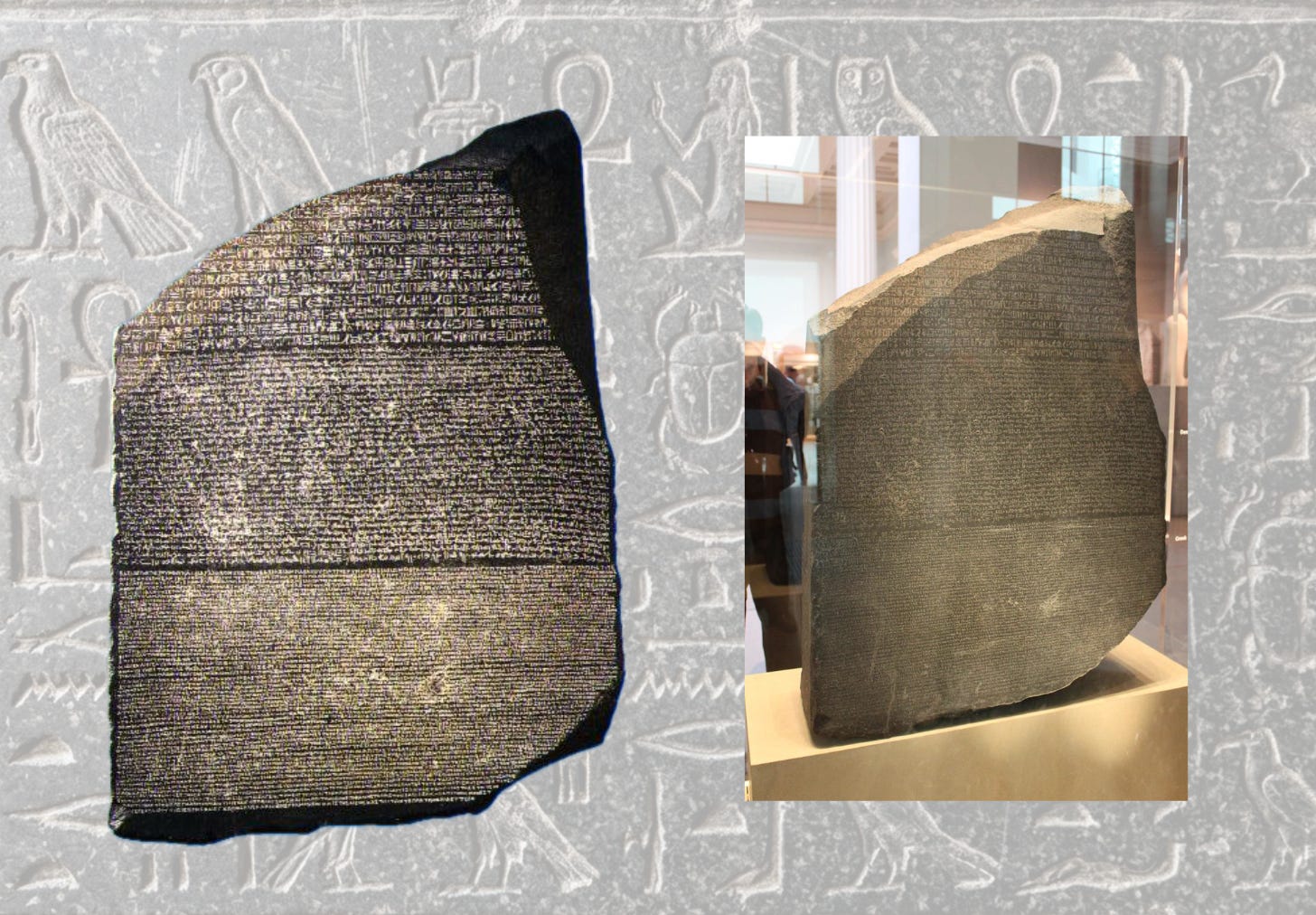
All you ever need to translate many codes is a key. That was the problem many ancient academics faced when they encountered languages they had not seen before. The Rosetta Stone became the key they needed.
The inscriptions on the Rosetta Stone were carved in 196 BC, making it over 2,200 years old. We now know that the date marks the official anniversary of the coronation of the young Egyptian King, Ptolemy V.
The stone is a broken part of a bigger slab, known as a stela. It is dark-coloured granodiorite. What made it exceptional was the message, written in three scripts: Demotic, hieroglyphic, and Ancient Greek.
Discovery
In July 1799, French soldiers found the stone near the town of Rashid (Rosetta) during Napoleon’s invasion of Egypt. Napoleon had campaigned in Egypt with the intention of dominating the Eastern Mediterranean and threatening Britain in India.
The exact story of how the stone was found is fairly vague. Historians believe soldiers digging foundations for a fort extension at Fort Julien accidentally discovered the artefact, embedded in an old wall. The officer in charge, Pierre-François Bouchard, quickly realised the importance of the discovery.
After Napoleon’s defeat, the stone was handed over to the British, along with other artefacts, as part of the Capitulation of Alexandria.
The Key
Academics quickly discovered that the stone had three scripts: Demotic and hieroglyphics, both Egyptian, and Ancient Greek. Hieroglyphics, the language of priests, were used for writing, while Demotic, the administrative script of the Egyptian people, was used for everyday writing. Ancient Greek was the language of the Macedonian rulers of Egypt, installed following Alexander the Great. The exciting part was that scholars could read Greek.
Scholars began decoding Egyptian scripts using Greek as a key. They matched the phonetic sounds of the Greek names of kings and queens in the inscription to other scripts.
An infamous rivalry soon developed between two scholars attempting to decipher the hieroglyphs: Thomas Young and Jean-François Champollion Young, the elder by seventeen years, made significant progress with both the hieroglyphic and Demotic scripts. However, Champollion led the final breakthrough. Champollion had dedicated his intellectual efforts since childhood to ancient Egypt and had studied Coptic under Silvestre de Sacy. These efforts paid off when Champollion confirmed the hypothesis that Egyptian hieroglyphs indicated phonetic sounds.
At this moment, he became the first person in well over a millennium to read the cartouches of Ramses and Thutmosis in their original language.
The Message
As valuable as the cypher was, so was the message portrayed on the stone. It states that the priests of a temple in Memphis, Egypt, confirmed Ptolemy V as a divine ruler he was Macedonian, not Egyptian. At the time, the king was just thirteen years old.
The decree mentions Ptolemy’s suppression of the Delta rebellion and the siege of Lycopolis. Despite their defeat, the Delta resistance persisted until 186 BCE, when royal authority was restored, as confirmed by the Rosetta Stone.
The decree itself is a complex document detailing the negotiation of authority between two powerful groups: the royal house of the Ptolemies and the collective associations of Egyptian priests.
Ptolemy V became king after his father’s death, but his official coronation in Memphis was delayed for nine years until he was older.
You can read the full translation here.
Modern Display
The British took possession of the stone and shipped it to England, arriving in Portsmouth in February 1802. King George III presented it to the British Museum in July of that year.
The stone has been on display in the British Museum ever since, with only one major break. Towards the end of the First World War in 1917, the museum was concerned about heavy bombing in London and moved it to safety 50 feet underground in a Postal Tube Railway station at Holborn, along with other important artefacts.
The Rosetta Stone is proof that all you need to break any code is one small key that unlocks it all. It is also a testament to the imperial ambitions of both France and England to establish empires across the globe.
The Amateur Who Beat the Academics

Michael Ventris was 14 when he first saw the Linear B script of Minoan Crete. He was on a school trip to the Royal Academy of Arts in 1936. That day, Sir Arthur Evans, who had found the script, was also there. Michael asked Sir Arthur if anyone had translated the script, and Evans replied, “Sadly not.” This started a lifelong obsession.
Subscribe today: I spend hours digging through archives, old testimony, and forgotten files to bring these cases to life. Free posts are just the beginning, paid subscribers keep this work possible and get access to my full vault of articles.
If you’ve enjoyed this story and want to see more, please consider upgrading. It’s readers like you who keep Murder Mayhem UK alive.