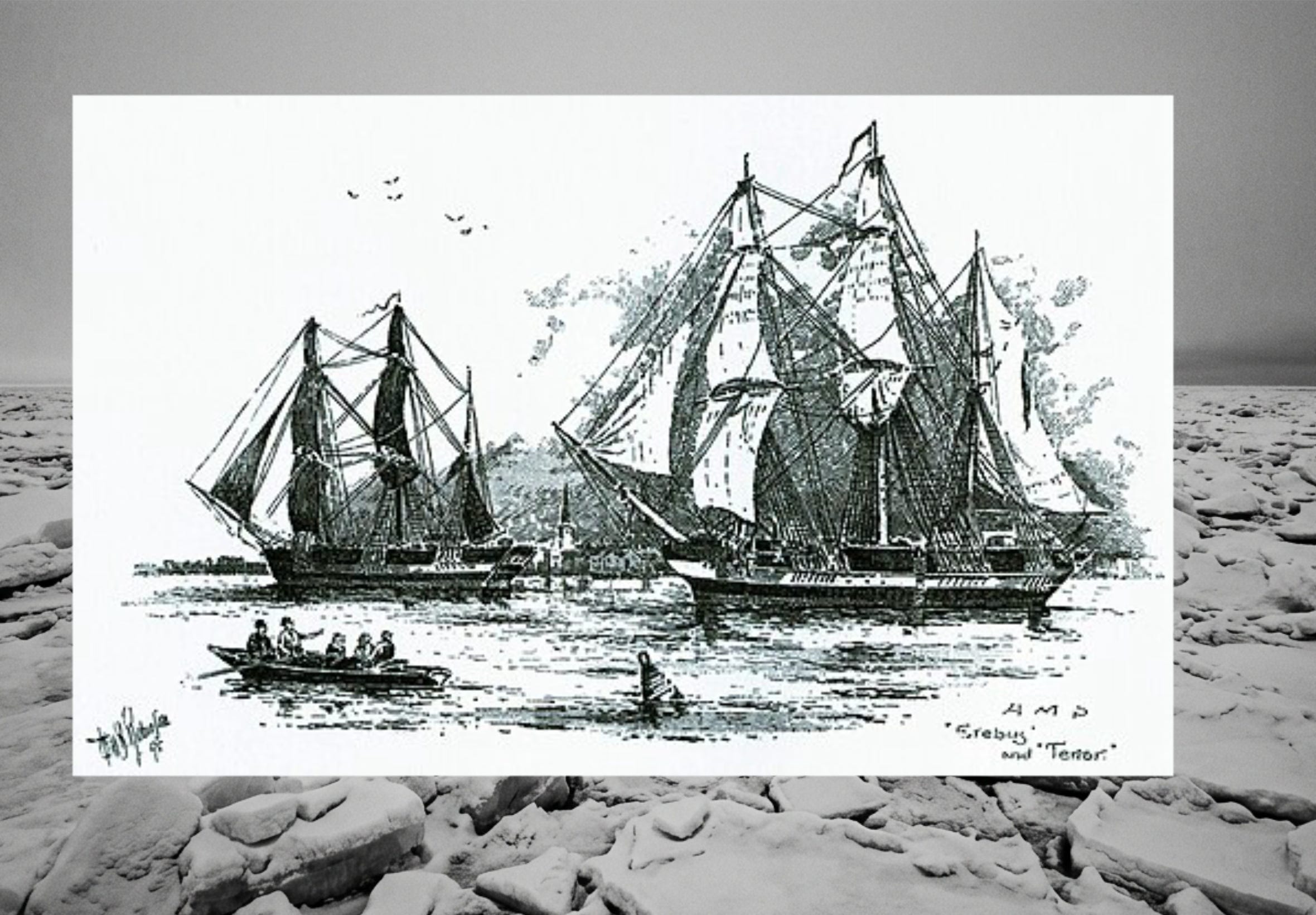
The race was on to map the world. The Victorian era saw the British Empire expand, and much of the world was mapped. One area remained undiscovered, though. That was the North West Passage.
The Franklin Expedition hoped to map this passage along the top of North America. They wanted to find a way to travel directly from the Atlantic to the Pacific coast. Many expeditions had failed. But the trip backed by the British government and led by Sir John Franklin would be different. Or would it?
HMS Erebus and Terror
Sir John Barrow, Second Secretary of the Admiralty, conceived the mission. He took two of the finest ships, the HMS Erebus and HMS Terror. Both had been Navy bomb vessels converted for this type of exploration. He kept their full sailing rigs but also equipped both with coal-powered steam engines and screw propellers for extra power.
Both ships had iron sheeting reinforcing their hulls, a propeller that retracted in the ice, and steam engines. They also had futuristic technology. This included a water purification unit, one of the first cameras, and an insulated diving suit. Lastly, they carried two inventions to improve the lives of the crew exponentially: internal heating and canned food.
The task was then to find someone to lead the mission. Several applied. Two who were deemed unfit to lead the mission were given individual Captain roles on the ships. The group eventually settled on Sir John Franklin to lead both vessels. Franklin was a veteran of two previous Arctic expeditions. He had his critics, but overall, public opinion was high for a successful mission.
Lastly, fully equipped with 134 recruited crew members, the two ships set sail on 19th May 1845.
Stromness
The two ships were flanked by two tugs to carry additional coal and an additional supply ship. As they entered the North Sea, the challenge of the voyage was realised. They hit a horrendous storm. Franklin would not turn back. The tugs turned back, but the Erebus, the Terror, and the supply ship reached Stromness on 31st May.
The ships needed supplies. However, the town did not trade until Monday, so the ships sat in port. The sailors enjoyed some downtime, although Franklin banned drinking.
The weather eventually died down. On 3rd June, the two ships and the supply ship sailed into the Atlantic. Once the convoy reached Disko Bay in Greenland, the support vessel left the two large ships. A couple of the men who had fallen ill returned with it, reducing the total crew to 129.
Towards the end of July, two separate whaling ships saw and interacted with the two vessels. This was the last time either of the ships or any of the crew would be seen, sparking a mystery of what happened to the Franklin Expedition that has endured for centuries.
Missing
Most in England expected to hear from the expedition in one to two years. None more so than Lady Franklin, a close friend of Charles Dickens, who was waiting for news of her husband.
When the expedition failed to report, most in Parliament presumed the crews had perished. Lady Franklin would not take this as an answer. Along with Dickens, who wrote many articles, she lobbied to have a search mission sent for the two ships.
In 1859, Sir Leopold McClintock sailed out to search for the Franklin expedition. McClintock had been a favourite to lead the original voyage but had been persuaded by his wife that the mission was too dangerous. However, he could not say no to rescuing his friend John Franklin.
There was no sign of either ship. However, the search team found two stone-built cairns on King William Island. In them, they found two handwritten notes.
What Happened to the Franklin
From the notes they found and subsequent exploration, it appears that the two ships became stuck in the ice. The year they travelled, the North West Passage was particularly cold and the ice floes larger than average. The year also boasted a cold summer, causing few of the ice floes to melt. The two ships became stuck and then waited for a summer thaw that never came.
In the spring of 1847, the party travelled across the ice to Point Victory and deposited the written record into the cairns. They then returned later to the notes to add to their story, stating that John Franklin had died in June 1847.
Trapped in ice and drifting south, Captain Crozier abandoned ship on 22nd April 1848.
Weakened from starvation and scurvy, 105 surviving men had fled across the land to find civilisation, dying en route. Very few bodies have ever been recovered from the expedition. However, those who have, with modern technology, may tell a different story as to the decline of the men.
Modern Exploration
Few bodies have ever been found of the crew; however, those that have have been the subject of speculation in modern exploration. Testing the bodies, scientists found that all had a high level of lead in their blood. Further investigation pointed to the revolutionary tinned food that had been stored on the ships.
The Franklin Expedition was one of the first to carry tinned food. However, these had been made at speed, and the solder that had been used to produce the tins leaked into the food, causing many of the crew to become ill with lead poisoning.
Following this conclusion, the team looking into the exhibition discovered the ships almost perfectly intact in the ice. HMS Erebus was discovered in 2014, and HMS Terror in 2016. It is hoped that the ships will contain more answers to what happened to the Franklin Expedition and the men who set sail over 150 years ago.
Be sure to check out our deep dive article on Monday, where we look at a ship that no one believed was real: The Hughes Glomar Explorer
Subscribe today: I spend hours digging through archives, old testimony, and forgotten files to bring these cases to life. Free posts are just the beginning, paid subscribers keep this work possible and get access to my full vault of articles.
If you’ve enjoyed this story and want to see more, please consider upgrading. It’s readers like you who keep Murder Mayhem UK alive.


The remains of the Erebus and the Terror might have been discovered earlier had the investigators treated the local Inuit population, who knew the full truth, with more respect. Instead, racism and ethnocentrism made it unknown to the wider world for over a century.