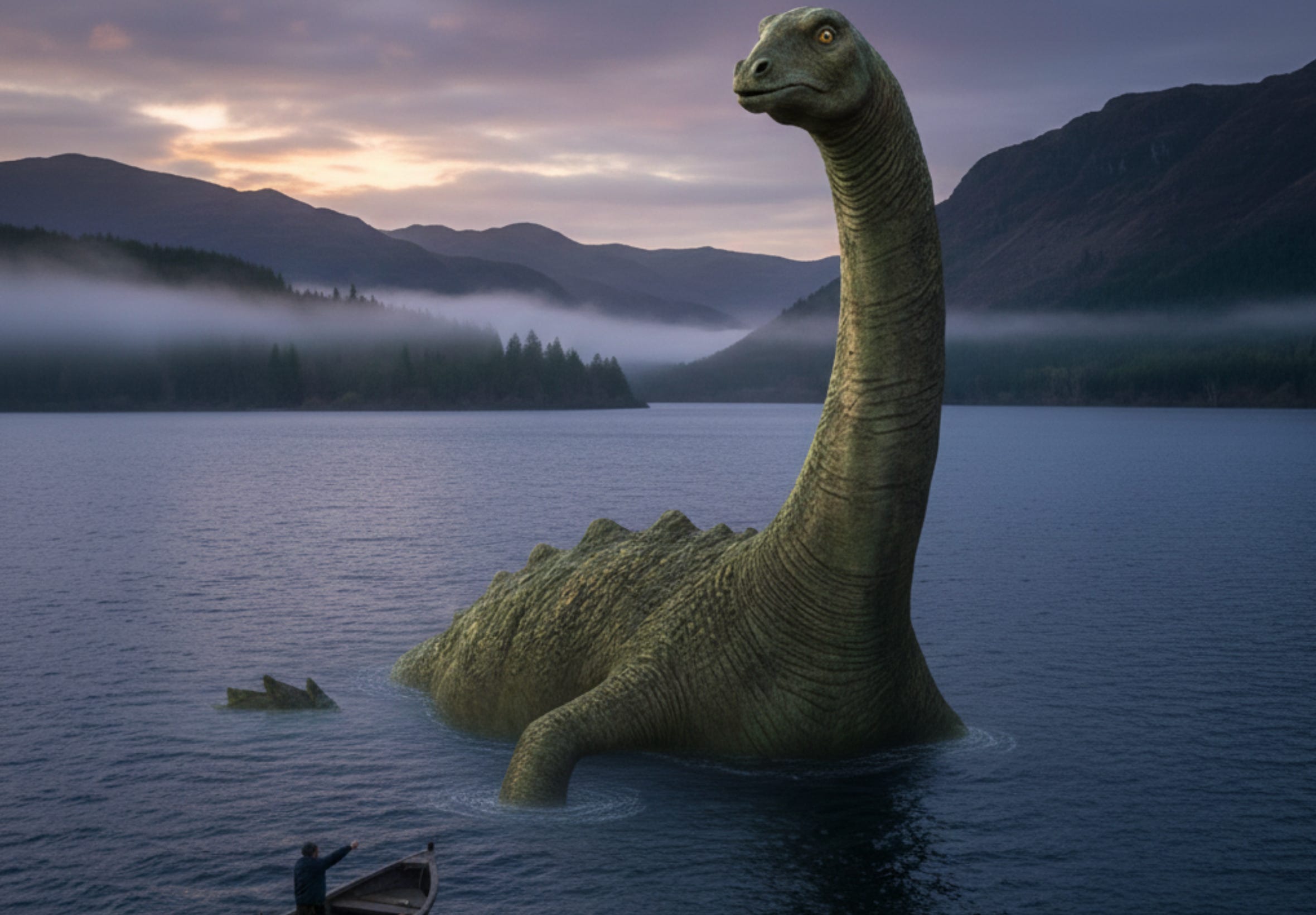
There are many stories of unknown monsters: Bigfoot, the Yeti, and the Almas. But, the one that has always fascinated me is the one I live closest to, the Loch Ness Monster, affectionately known as Nessie.
Nessie serves as a primary example of “cryptozoology,” the study of animals not proven to exist.
Nessie reportedly inhabits the deep, dark waters of Loch Ness in the Scottish Highlands. The sheer scale of the loch is staggering; it holds more fresh water than all the other lakes and rivers in England and Wales combined.
Despite its northern location, the water never freezes. The massive volume of the loch acts as a heat reservoir; as the surface cools, it sinks and is replaced by warmer water from the depths. This constant circulation keeps the temperature at a remarkably steady 6°C (42°F) all year round.
The water itself is dark and murky, some would even call it dirty, due to the rich peat that washes down from the surrounding hills.
These conditions, coupled with the fact that the loch sits directly atop the Great Glen Fault, have kept the myth alive. The fault line creates a straight trench with underwater fissures and steep drop-offs, providing the perfect hiding spot for a giant creature to evade detection.
Nessie has fascinated generations of speculators. Today, she remains a cultural icon, significantly boosting the tourist trade and contributing an estimated £25 million annually to the local economy.
Ancient Roots and Modern Sightings
While modern tourists flock to the shores with cameras, the monster’s roots reach back into ancient legends. Stone carvings by the Picts hinted at strange aquatic creatures long before the modern era. Indeed, written accounts date back to 565 AD, when the Irish monk St Columba reportedly encountered a beast in the River Ness.
As the centuries passed, sightings and photographs continued to emerge. While many have been debunked, a persistent few remain unexplained.
The legend gained a literary boost in the early 20th century through Arthur Conan Doyle. Famous for Sherlock Holmes, Doyle also penned The Lost World, a novel describing an Amazonian expedition that discovers prehistoric creatures on a hidden plateau. This story captured the public imagination, leading many to wonder: if prehistoric life could survive in the Amazon, why not in the Scottish Highlands?
Sighting Statistics
The statistics for Nessie sightings are truly impressive. To date, the official register records 1,156 sightings. A pivotal year was 1933, when Aldie Mackay reported a whale-like creature in the water. Shortly thereafter, George Spicer and his wife claimed a long-necked creature actually crossed the road in front of their car.
Further sightings that same year included a photograph by Hugh Gray, though sceptics later suggested it depicted a dog with a stick, or an otter. A year later, veterinary student Arthur Grant sketched a creature he nearly collided with on his motorbike; however, zoologists again dismissed the sighting as a misidentified otter.
These events set the stage for 1934, the year Dr Robert Wilson produced the famous “Surgeon’s Photograph”—the primary subject of Monday’s upcoming article.
Scientific Expeditions
Following these early reports, the mid-20th century saw the start of formal scientific investigations, proving that not everyone was ready to dismiss the monster as a mere hoax.
Between 1962 and 1977, the Loch Ness Investigation Bureau conducted the first significant exploration. While they failed to find definitive evidence of Nessie, they also failed to prove that a large creature wasn’t lurking in the abyss.
Later, researchers like Rines and Wyckoff deployed sonar scans, which detected unexplained underwater objects and a strange fungus-like organism. In 1960, the Dinsdale Film captured a dark hump moving through the water; although critics argued it was a boat, the footage was never officially disproved.
The search intensified in 1987 with Operation Deepscan. This involved twenty-four boats using sonar to sweep the entire loch. They registered contacts larger than a fish, though critics claimed these were likely logs or sunken debris.
Most recently, the 2023 exploration, the largest hunt in 50 years, utilised thermal drones and hydrophones. While it recorded four distinct, unexplained noises, it ultimately found nothing definitive.
The Theories
Seeking a rational explanation, scientists and enthusiasts have proposed several identities for the monster. One prominent theory suggests Nessie is a surviving Plesiosaurus\ dolichodeirus, a marine reptile from the Mesozoic era.
However, this theory faces a major hurdle, there is no evidence of a breeding population, and decades of dredging since the 1970s have failed to uncover a single plesiosaur bone on the loch floor. On the other hand, the loch’s extreme depth and unexplored underwater caves leave just enough room for doubt.
Another compelling theory states that the monster is a giant European conger eel. While these eels can grow up to 6 feet long, the gargantuan size required to match eyewitness accounts remains a point of scientific contention.
Natural Phenomena and Hoaxes
Despite the enduring mystery, a strong community of sceptics remains. They often attribute sightings to floating logs, or the misidentification of known animals like sturgeons, seals, and otters.
Some researchers even suggest that travelling circuses in the 1930s allowed their elephants to bathe in the loch, which would explain the sightings of “trunks” and “long necks” rising from the water.
Even though no one has produced an authentic fossil or a crystal-clear photograph, the hope persists that Nessie represents a species uniquely adapted to this environment.
Every part of my rational brain argues that an undiscovered creature can’t inhabit a Scottish loch, yet if you asked me, I still believe in the Loch Ness Monster.
Be sure to check out our deep-dive article on Monday, where we investigate two spectacular hoaxes that fooled the world.
Until next Wednesday: Stay safe, stay curious.


