Why Smart People Fall for Famous Scams
From New York’s original “Con Man” to the £13 million mortgage queen, how empathy becomes a weapon.
Undoubtedly, some will read this article and think, “This would never happen to me.” To think that would be naive; I have nearly been caught a couple of times myself.
When I was researching this article, I had a chat with the national fraud agency in the UK.
Curiously, identity fraud is not even considered a criminal offence in the UK. With this logic, I questioned what stops me from getting a credit card in someone else’s name.
The answer? The company you use the credit card with could pursue a claim for theft, but the individual whose identity was stolen cannot. Like many things in the UK, the law protects the big companies whilst pushing the everyday working person to the kerb.
Although illegal in the US, it is considered extremely hard to prove. The fact is that every one of us who goes on the internet could be a victim of identity fraud or an online scammer. Here are some of the most famous and profitable scammers in history, ordinary people who used their charm to con millions out of others.
William Thompson
One of the world’s original con men was William Thompson. He is actually the person who inspired the term “con man.” Thompson was renowned for stealing watches in New York.
Thompson would use a psychological tactic to gain his bounty. He would approach a stranger and ask: “Have you confidence in me to trust me with your watch until tomorrow?”
The “con” wasn’t the theft itself, but the social pressure he placed on the victim to prove they were a “trusting” person. Clearly, they never got their watch back.
He used various aliases while scamming the New York elite. He was finally caught in 1849, and an article dubbed him a “confidence man,” which was later shortened to the term we use today.
Linda Taylor
Over the course of her life, Linda Taylor was known by many different names while committing welfare fraud on multiple occasions. She didn’t just assume many names; she was known to identify as Black, Asian, Hispanic, and Jewish. This is a classic example of affinity fraud, where a scammer mimics the identity of a specific group to exploit their trust and empathy.
Taylor pretended to have many different jobs, posing as a nurse, a doctor, and a spiritual advisor. For all of these fake identities, she possessed forged identification documents.
So blatant was Taylor that in 1974, she filed a police report claiming she had been robbed of $14,000 in cash, jewellery, and furs. When the police came to investigate, they grew suspicious; they recognised her as someone who had filed a similar false report previously.
Further investigation uncovered multiple welfare cheques made out in different names. They then discovered she was wanted for welfare fraud in Michigan. Taylor fled to Arizona but was caught later. As the story unravelled, she was indicted on charges of fraud, perjury, and bigamy. It was estimated that she had received over $100,000 in fraudulent cheques.
Taylor’s case became a massive piece of American political history. During his 1976 campaign, Ronald Reagan used her story to popularise the term “Welfare Queen.”
While she was a legitimate criminal, her specific case was used to argue for systemic welfare reform. Later, it was discovered she had an even darker side to her personality. Investigative journalist Josh Levin discovered she was linked to the disappearance of a baby and potentially several suspicious deaths, suggesting her con artist persona was just the tip of the iceberg.
Maria Michaela (Wendy Barlow)
The woman known as Maria Michaela (whose real name was Wendy Barlow) was named the UK’s most prolific female fraudster after conning banks out of £13 million. Her method involved submitting offers on houses well over the market value and then defaulting on the mortgages.
She did not work alone; she manipulated a network of surveyors and solicitors to verify her inflated valuations. At the height of her success, she lived in a £1.5 million penthouse in Blackheath and drove a Bentley. She created many false identities to enable her to repeat the scam multiple times until her arrest in January 2012.
Jim Bakker
In 1979, Bakker was investigated by the FCC for misusing funds raised on-air. A large part of his business model involved raising money through shows, claiming the proceeds were being donated to mission trips and people in need. This represents another form of affinity fraud, using shared religious beliefs to lower a victim’s guard.
By 1982, it was revealed that Bakker had told audiences that $350,000 was going overseas to missions, but the money had actually gone to fund Heritage USA. The report found that Bakker used the funds from his shows for personal expenses.
Investigations by the IRS showed that $1.3 million from the ministry expenses had actually been siphoned into personal accounts. Bakker was indicted in 1988 on eight counts of mail fraud, fifteen counts of wire fraud, and one count of conspiracy.
He was found guilty on all twenty-four counts and sentenced to forty-five years in prison.
He actually served only six years, being released in 1994 to become a doomsday prepper. He currently sells “Giant Buckets of Survival Food” on The Jim Bakker Show. He often claims these buckets can last 30 years and are essential for the coming apocalypse.
Ethel McGill
McGill claimed that her dead father, Robert Dennison, was still alive, carrying on claiming his war pension and benefits long after he died in 2004.
At one point, she went as far as asking a friend to lie under a blanket to pretend to be her father. McGill then went on to claim that she had a disability and dementia for two decades. She pocketed roughly £750,000 over three decades.
Eventually, investigators from the Department for Work and Pensions acquired a video of her driving and moving around, despite her claims of dementia and needing a wheelchair. She was jailed in 2019.
Maria Duval
Duval ran a mail-order astrology scheme where she targeted the elderly and sick. The readings were said to be personalised; she even went as far as covering them in coffee stains to make them look authentic, though they were actually printed on.
The company was pumping out thousands of fake letters a week, raking in a profit of $200 million. With each letter costing $40, some victims kept in contact with her for years, spending thousands of pounds to seek her advice.
Duval, the face of the scam, had appeared on television as a psychic. Her son later stated he believed she agreed to front the scam because she wanted to become rich and famous, but she got in too deep.
The US Postal Service called it the largest consumer fraud they had ever handled. Duval’s home in France was searched in 2018, but she was not arrested. However, several associates with links to the scheme were charged with mail fraud.
Many Famous Cases
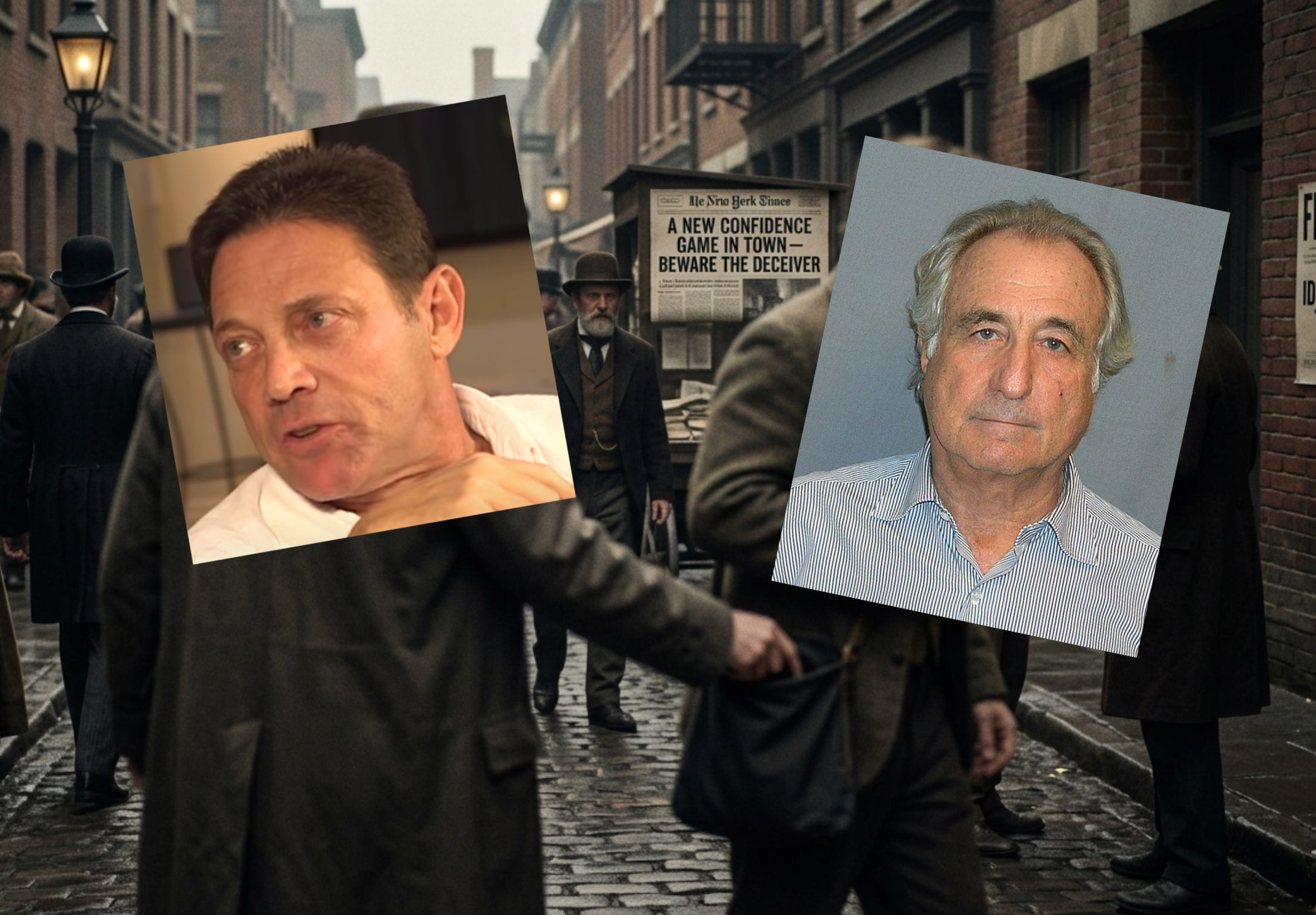
These are some scammers you may not have heard of. There are several, however, that are household names. Jordan Belfort, portrayed by Leonardo DiCaprio, manipulated stocks for Stratton Oakmont; it was estimated that his actions cost investors over $220 million.
Bernie Madoff, who pulled off one of the largest Ponzi schemes in history, was estimated to have robbed his clients of $64.8 billion before he confessed.
The common thread in almost all these cases is affinity fraud—the act of targeting people who share a similar background, religion, or age group. Whether it’s Bakker using faith or Duval using the vulnerability of the elderly, these scammers succeed by turning a victim’s own empathy or hope against them.
These scammers prove that there are many people who prefer to earn a living by lying to others. Whether it is defrauding the government or taking money from innocent people under false pretences, scammers are always around to make a quick buck.
Be sure to check out our deep-dive article on Monday, when we look at one of the most famous scammers known: Frank Abagnale. You think you know his story, but you might not.
Until next Wednesday: Stay safe, stay curious.


